

A Weak Justification for Dropping ShotSpotter
Concrete Evidence (June 1, 2026)

“The data proves we’re doing what works: investing in communities, improving response times, and giving police officers tools that are effective,” Chicago Mayor Brandon Johnson announced on X last week. “Not wasting taxpayer dollars for walkie talkies on poles that overpolice communities without improving safety.”
He was referring to a brief analysis from the University of Chicago Justice Project, which purported to show a 4.2-minute improvement in response time to “Priority 1” 911 calls—calls that require an immediate response—as well as a decline in violent crime after the city ended its use of ShotSpotter.
ShotSpotter is, basically, a system of microphones that monitor for the sound of gunshots in designated areas and, after human review of any gunfire-like bangs, turns the audio and estimated coordinates over to the cops.
The Justice Project’s analysis is weak sauce, despite the intense coverage it’s received in the Chicago media. The results have little bearing on the question of whether Chicago did the right thing by ending ShotSpotter in late 2024, or whether Johnson’s administration is doing the wrong thing by dragging its feet as it searches for a replacement.
To begin with, as the crime-watchers at CWBChicago promptly reported, the underlying data are less than perfect—the city doesn’t record response times as reliably as it should. Further, there are two significant sleights of hand in the analysis itself, key details the authors buried in fine print at the bottom of the web page where they presented their results.
First, the analysis uses two different time periods. When analyzing crime rates, the authors contrast the first nine months of 2024 and the first nine months of 2025—a sensible way of addressing the fact that crime is seasonal, rising in the summer and plummeting in the (frigid, if you’re in Chicago) winter. They explicitly note this time period not just in the fine print but also in the main text of the analysis.
By contrast, when they look at response times, the main text merely refers to an unspecified period “after ShotSpotter was removed.” Only by reading the fine print do we learn they are comparing “the six months right before the shutdown of ShotSpotter in 2024 and the first six months right after the shutdown.”
Which is to say that they are comparing, basically, a spring and summer with ShotSpotter to a fall and winter without it. This is a problem because, much like crime in general, Chicago’s Priority 1 calls have a strong seasonal pattern:
Chicago Priority 1 911 Calls
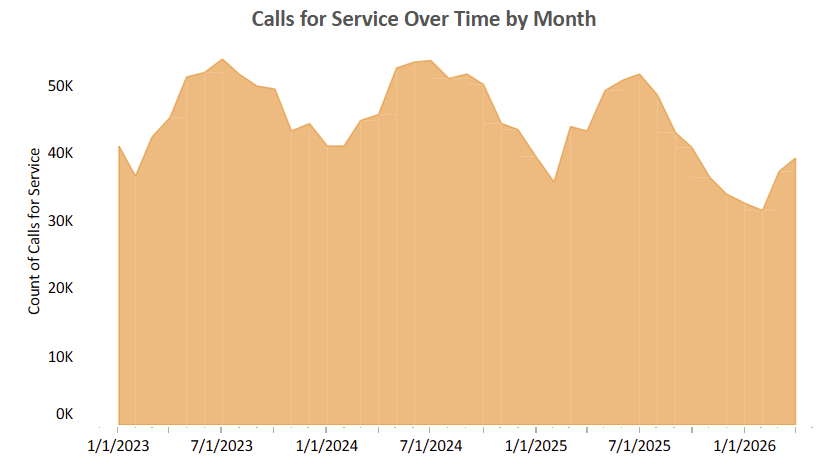
There are simply fewer calls to respond to at colder times of the year. Further, this will have a bigger impact on the higher-crime areas where ShotSpotter was installed—which helps explain why, according to the analysis, ShotSpotter areas had twice the response-time improvement that non-covered areas did.
Incidentally, that same number implies that if the authors had used non-covered beats as a control group, rather than just comparing response times in ShotSpotter areas at two different parts of the year, their headline 4.2-minute result would have been cut in half.
The other issue CWBChicago flagged is that the researchers removed gunshot calls from the data. To be clear, there’s nothing inherently wrong with analyzing high-priority non-gunshot calls specifically. If, for example, ShotSpotter improved responses to gunshot calls but undermined responses to other calls, that would be worth knowing. But this is something readers should have been told up front, rather than being buried in fine print.
I’d like to add a few points to those raised by CWBChicago as well.
One is that Chicago’s recent crime decline has mirrored an improvement for the overall U.S.; over the past four years, murders have fallen by nearly half in both. This makes it difficult to tell what’s driving trends in the Windy City specifically, either citywide or in the higher-crime neighborhoods that had ShotSpotter—and it shows why accounting for the annual seasonality of crime trends, while necessary, does not isolate the impact of ShotSpotter itself.
If you thought ShotSpotter magically cut crime by 75 percent everywhere it’s installed, I suppose the similar crime declines in Chicago and the rest of the country should disabuse you of that notion. More realistically, though, the system might modestly reduce crime by getting cops to scenes a bit faster and producing extra evidence, and this analysis can’t distinguish such nuances from broader trends and noise in the data.
The balance of work between Priority 1 911 calls and ShotSpotter alerts is also worth pondering. As depicted in the chart above, Chicago police receive around 30,000 to 50,000 Priority 1 calls per month. Under ShotSpotter in 2024, the department was also getting about 2,000 to 3,000 monthly ShotSpotter alerts that weren’t accompanied by a 911 call about the same noises. The department’s work is divided amongst 11,500 officers.
What to make of such figures? The department has a lot on its plate, its current staffing is not sufficient for the challenges it faces, and responding to ShotSpotter calls certainly can have some impact on response times for other matters. Given that Priority 1 response times exceed ten or even 15 minutes on many beats even in the authors’ second period, these are clearly serious concerns. Nonetheless, the high ratio of top-priority 911 calls to ShotSpotter alerts should make us skeptical of a big role for the latter in overall response times.
ShotSpotter comes with real tradeoffs, which I laid out in considerable detail in a report last year. In general, it does seem to get cops to the scene of likely gunfire more quickly than 911 calls and boost evidence recovery, and it does sometimes alert cops to incidents they wouldn’t have heard about otherwise.
It also leads cops to scenes where they can’t find physical evidence of gunfire, though, and making the most of it requires manpower than some departments are lacking, with studies divided at best as to whether it leads to concrete improvements in crime and clearance rates. Eric Piza’s studies of Chicago have showed improved response to gunshots and increased firearm recoveries but no measurable improvement in crime or clearances.
I could buy that Chicago wasn’t making the most of the technology or simply didn’t have the staff to do so. And I’m eager to see more studies on the impact of shutting the system off. But hopefully future studies will feature more serious analysis than what the mayor is pushing.
From the Manhattan Institute
Chris Pope on reining in Medicaid managed care.
Over at City Journal’s main site, Barry Latzer and Kristofer Bret Bucklen break down the crimes of parolees.
Other Work of Note
Nature Human Behavior publishes a critique of a study that had claimed “anti-transgender” laws increased suicide attempts among trans and non-binary teens.
Ride-sharing might be good for the environment in dense cities. Apparently, it enables people to rely less on their own cars and more on public transit (presumably using ride-sharing to fill in the gaps).
A CBO tool for projecting discretionary spending.
New data on the ideological diversity of college faculty.
Big new survey of parents.
AI vs. people for reproducing scientific findings.
Have we bent the health-care cost curve?
Global support for gender egalitarianism has plateaued, partly because “fertility is higher in countries where average support for gender equality is lower.”
Trends in maternal mortality.
Testing a (fairly silly?) 1972 conjecture from Ronald Coase about the behavior of monopolists.
If top colleges reduce graduate enrollment in response to the endowment tax, will that slow scientific progress?
What does free community college achieve?
Tax competition and economic growth.
Ideas for bringing down crime in D.C. with hot-spots policing.
Who cares for kids when mothers go to prison?
“Does violent delinquency predict premature death?” (Spoiler alert: Yes.)
Breaking down substance abuse among men who are not employed or in school.
More small-but-positive impacts from school cell-phone controls, this time in Brazil.
More podiatrists, fewer amputations for diabetics?