


Last Thursday, amid chants from activists in a packed hearing room, New York City’s Rent Guidelines Board handed Mayor Zohran Mamdani a small victory for his “freeze the rent” campaign promise. In a preliminary vote, the board approved possible rent adjustments of 0 to 2 percent for one-year leases and 0 to 4 percent for two-year leases on the city’s rent-stabilized apartments.
If finalized at the board’s June 25 meeting, the decision would affect more than one million rent-stabilized apartments across the five boroughs. With that vote, Mamdani will (sort of) secure his biggest campaign promise: holding rent increases on stabilized units below inflation.
For tenants, that may sound like relief. But keeping rents artificially low does not eliminate the cost of housing; it shifts the burden elsewhere. New Yorkers will pay in the form of more buildings falling into financial distress, deteriorating housing conditions, and greater pressure on market-rate rents as demand spills into a tighter unsubsidized market.
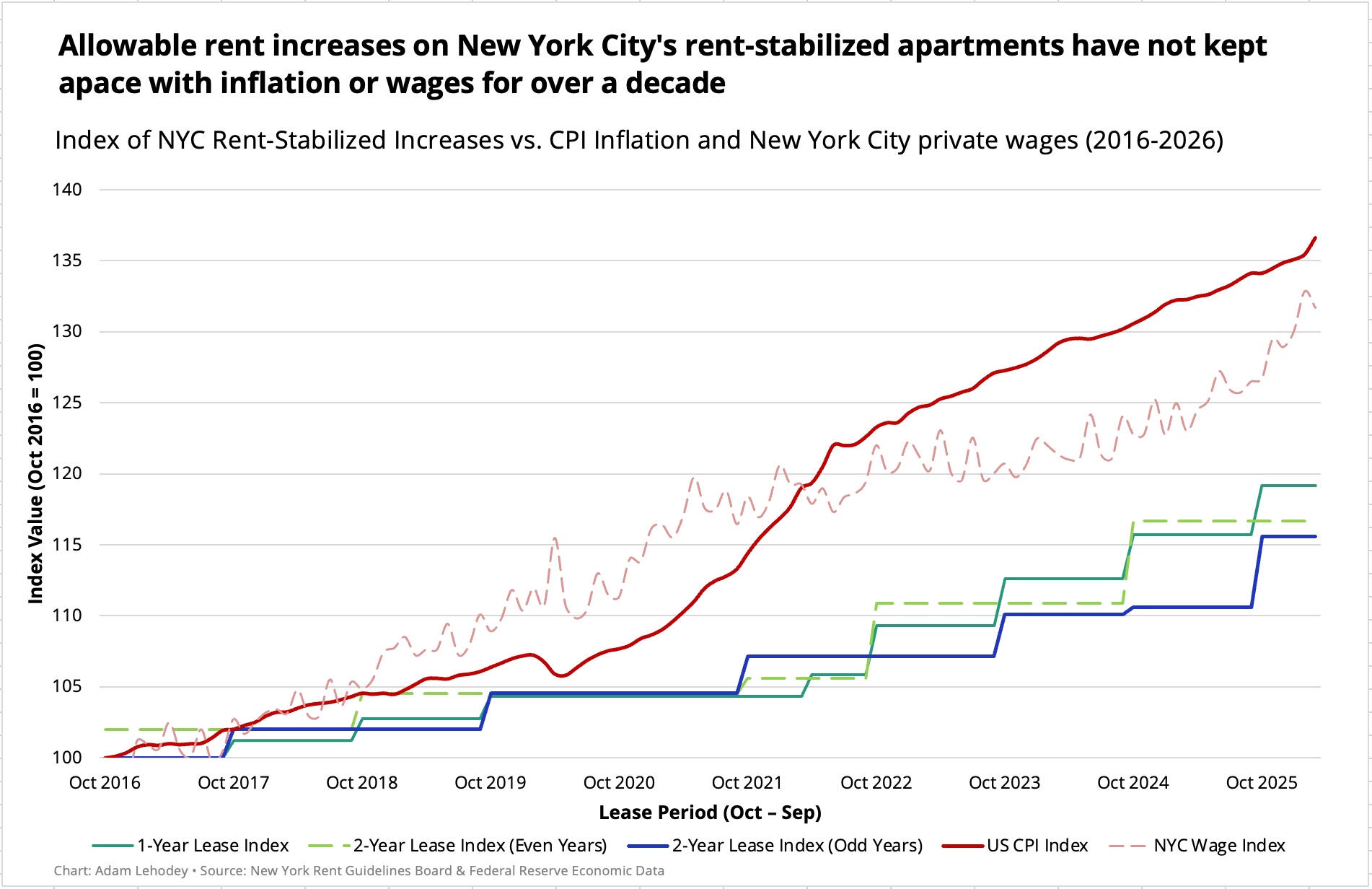
Thursday’s vote was not an outlier. For much of the past decade, the rent increases approved by the Rent Guidelines Board have consistently failed to keep pace with inflation. Over the past decade, allowable rents on stabilized apartments rose just 17 percent. At the same time, the city’s labor costs increased by 31 percent, while the overall price level as measured by consumer price index increased 36 percent.
The result, as Howard Slatkin explained last year for Vital City, is a rent-stabilized housing market that is increasingly divided. Buildings constructed under the 421-a tax incentive—which requires that units be rent-stabilized for the duration of the developers’ tax exemption—had base rents that were much higher than other rent-stabilized units, and so are still able to meet expenses and turn a moderate profit. The same is true of buildings that contain a mix of rent-stabilized and market rate units, although the labelling of mixed buildings as “rent stabilized” artificially inflates the profit that landlords appear to make.
But many buildings, particularly those where most units are rent-stabilized, are in financial distress. Slatkin notes that in “core” Manhattan— south of 110th Street on the West Side and 96th Street on the East Side—only 16 percent of buildings are 100 percent rent-stabilized. In the rest of the city, 61 percent of rent-stabilized units are in fully stabilized buildings. These are the buildings in which operating expenses and maintenance costs are most likely to exceed revenues—which is already the case in about 10 percent of rent-stabilized properties across the city.
In such buildings, maintenance of major systems—including roofs, stairwells, kitchens and other amenities—is often deferred. Properties may remain rentable, but conditions slowly worsen, and tenants see fewer amenities. Over time, they pay less, but for worse quality housing. Thursday’s preliminary vote is likely to continue this trend.
Eventually, many rent-stabilized units will be removed from the market altogether, as the cost of repairs and maintenance exceed the rents that can be collected on them. Already, more than 50,000 units are now vacant across the city. This trend is worsened by the fact that, since 2019, landlords are no longer allowed to reset the rents on their units when they become vacant.
These costs are borne by all New Yorkers, and potential New Yorkers, in the form of lower vacancies. While the median rent in stabilized apartments averages $1,500, the median rent for a two bedroom market rate unit is $2,200. Tenants in stabilized units are therefore far less likely to move out, effectively trapping them in apartments. Across the city, the vacancy rate in stabilized units is nearly half that of market-rate units. All of this prevents New York’s limited housing stock from being used as efficiently as possible.
There are better ways to set rents on stabilized apartments. Rates could simply be pegged to the Consumer Price Index. The RGB could also be allowed issue different rent adjustments based on building quality: landlords who maintain and improve their buildings would be allowed to raise rents higher than those who do not.
The effect of these changes would, at the very least, mitigate the cost pressures that risk an increasing number of properties becoming financially distressed. In the meantime, however, political pressure has prevailed, and the condition of New York’s housing stock can only be expected to worsen.