

Data Centers in Space? It’s Complicated
AI companies are looking to orbit. The risk is turning space into a tragedy of the commons.

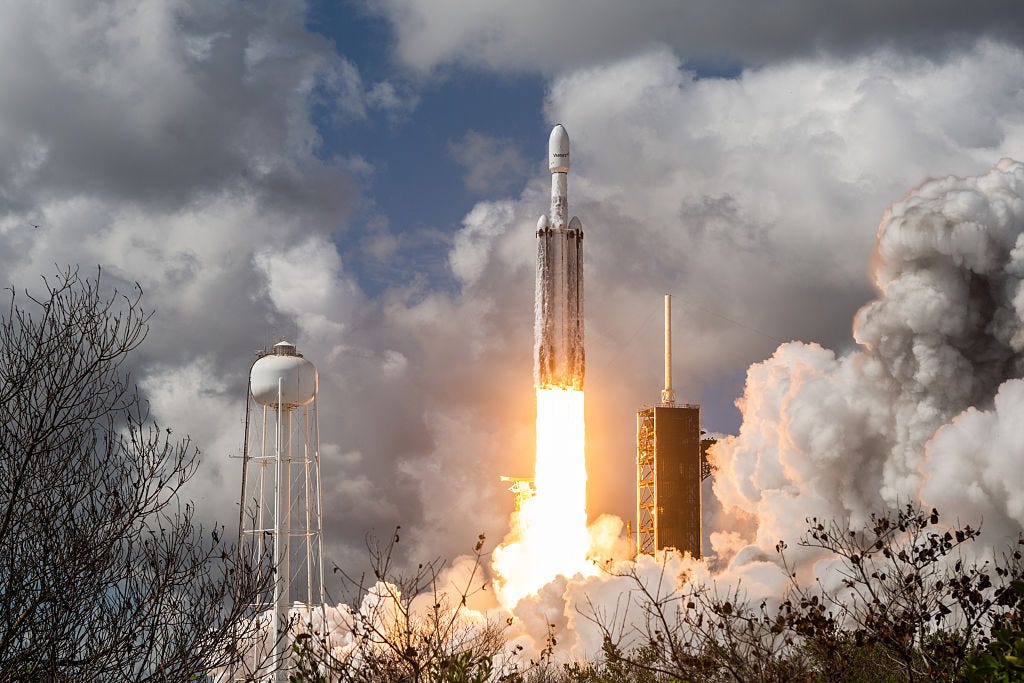
Data centers have become controversial on Earth, to put it mildly. Across the country, communities are pushing back against the massive facilities needed to power artificial intelligence due to concerns about energy demand, water use, noise, heat, and land use. Recent polling has found that seven in ten Americans would oppose a data center being built near them, making them even less desirable than living near a nuclear power plant.
That resistance has caused some companies to look for easier places to build—including beyond Earth itself. Several tech companies are actively pursuing the idea of launching data centers in space. These facilities would consist of constellations of satellites designed to process, store, and transmit data, powered by near-continuous solar energy and free from many of the local fights that now surround data centers on the ground.
The idea is appealing. But putting data centers in space would not avoid every hard policy question; it would raise new ones. Low Earth orbit is already a crowded place and is increasingly threatened by space junk and collision risks. Dramatically expanding the number of satellites could make orbit more congested and hazardous, reducing its value for everyone who depends on it. If orbital data centers become a serious part of the AI infrastructure buildout, policymakers and tech companies will need to confront a familiar problem in a futuristic setting: how to protect a shared resource before overuse makes it harder to use at all.
The logic behind orbital data centers is easy to understand. Modern AI requires enormous amounts of electricity and other resources. In space, satellites can draw on near-continuous solar power without competing with households or other terrestrial users for electricity. Space also offers a way to radiate waste heat without the water-intensive cooling systems that have made some data center projects controversial on Earth. And orbital data centers would operate far from permitting fights and political backlash that have stalled many projects on the ground.
For those reasons, the race to orbit is already underway. SpaceX, which went public last week, filed plans with the Federal Communications Commission in January to launch up to 1 million satellites for an orbital data center system. Google’s Project Suncatcher is exploring whether solar-powered satellite constellations equipped with the company’s Tensor Processing Units could scale up its machine-learning capacity, with two prototype satellites planned by early 2027. Startups such as Starcloud are pursuing similar ideas.
Yet there are significant obstacles to such plans. The engineering challenges alone are formidable. SpaceX has reportedly warned investors that space-based data centers involve “significant technical complexity and unproven technologies,” including launch costs, radiation, thermal management, and other factors. Among those challenges are also growing concerns about space debris and collision risk.
Low Earth orbit is already filled with operational satellites, dead satellites, and fragments from past missions, explosions, and collisions. Even tiny pieces of debris can be dangerous. A fleck of metal too small to see from the ground can still damage a spacecraft. A larger collision can create thousands of new fragments, increasing risks for every other object nearby.
This danger is commonly associated with Kessler syndrome: a cascading chain reaction in which collisions create debris, debris causes more collisions, and over time some orbits become unusable. A real-world warning came in 2009, when an active Iridium communications satellite collided with a defunct Russian Cosmos satellite, producing nearly 2,000 trackable pieces of debris and many more smaller fragments. That accident involved just two satellites. A future orbital data-center industry could involve hundreds of thousands of larger and more complex objects.
In this sense, space is a classic example of an open-access resource vulnerable to the tragedy of the commons. When no one owns a resource, each user has an incentive to overuse it. Under current regulations, operators cannot secure exclusive rights to orbital paths, nor can they recover costs they incur from someone else’s space junk. A company that launches satellites into a crowded orbit benefits from occupying that space, but it does not bear the full cost of the collision risk it creates for others.
Orbital data centers could exacerbate the problem in several ways. Compared with many existing communications satellites, space-based data centers would likely be much larger, more complex, and more difficult to manage. They would require large solar arrays, giant radiators to disperse heat, clusters of computing satellites flying in close formation, frequent replacement launches, and expensive hardware that cannot easily be repaired. The more hardware placed in orbit, and the larger it is, the greater the exposure to collisions—and the greater the risk that one failure imposes large costs on everyone else.
There are solutions to address congestion in open-access settings like this. In a 2020 paper, economists Akhil Rao, Matthew Burgess, and Daniel Kaffine proposed what they call an “orbital-use fee”—essentially a user fee for operating satellites in crowded orbits. Under this model, satellite operators would pay a recurring per-satellite charge that reflects the congestion and collision risks each satellite imposes on others.
In practical terms, the fee would work like congestion pricing for space. If an orbit is relatively un-congested, the cost would be lower. If an orbit becomes crowded and risky, the cost would rise. The fee could be assessed through national licensing authorities, such as the FCC.
That price signal would align incentives in important ways. Operators would only launch satellites whose benefits exceed the costs they impose. They would have reason to design satellites that are easier to maneuver, less likely to fail, and more likely to deorbit safely and promptly. The researchers estimate that the optimal fee would rise over time, reaching roughly $235,000 per satellite-year by 2040.
Why would policymakers—or tech companies for that matter—agree to make space commerce more expensive just as launch costs are falling and private companies are opening new frontiers? The answer is that, counterintuitively, an orbital-use fee could enhance the overall value of space. Under an open-access regime, companies can rush into orbit in ways that eventually degrade the resource and destroy its value. Rao, Burgess, and Kaffine estimate that a well-designed orbital-use fee could more than quadruple the long-run value of the satellite industry—and that estimate came before the AI boom made orbital data centers a serious commercial prospect.
This challenge will become especially important as certain orbital paths become more desirable, and thus more crowded. Data centers will be most effective in sun-synchronous orbits, which keep satellites on a consistent schedule relative to the sun. In the right configuration, that can mean nearly continuous solar power and less time in Earth’s shadow. But if many operators crowd into the same valuable orbital lanes, collision risks will grow.
Rao, Burgess, and Kaffine’s model assumes that an orbital-use fee would be “internationally harmonized,” meaning that countries would coordinate so operators could not simply avoid the fee by licensing through a more permissive jurisdiction. Achieving that kind of cooperation amid an increasingly competitive, AI-fueled space race will not be easy. But the costs of getting this wrong could be far greater than the costs of coordination. If valuable orbits become too congested or dangerous to use, every spacefaring nation and company will be worse off.
Regardless, the need for coordination is unavoidable. Ezra Feilden, co-founder and chief technology officer of Starcloud, has warned that operators pursuing sun-synchronous data centers will need to align their orbital direction. If some choose one direction and others choose the opposite, collision risks could become severe. “If even a small number of players decide differently from the rest then head-on collisions are essentially guaranteed,” he wrote last month on X. “A single collision would release 40 tons of TNT, quickly turning this very special orbit into a debris field.”
At a time when AI computing power is scarce, launch costs are falling, and the commercial space industry is still young, it may seem strange to argue for making orbit more expensive. But that may be exactly what is needed to preserve space as the next great technological frontier. If policymakers want space to remain open for commerce, science, security, and exploration, they should treat orbit not as a limitless void but as a valuable commons. The sooner they do, the better chance we have of keeping it usable.
"The logic behind orbital data centers is easy to understand"
And the maths that show the absurdity of the idea are easy to calculate.
This is Hyperloop in Space, pushed at us by a man who is extremely well known for promising investors Mars in order to get those $$'s rolling in, and then not even delivering the moon.
And when those investment chickens don't come home to roost, he just promises them bigger and better chickens, for the small price of more money.