

Do School Phone Bans Work?
Concrete Evidence (May 11, 2026)

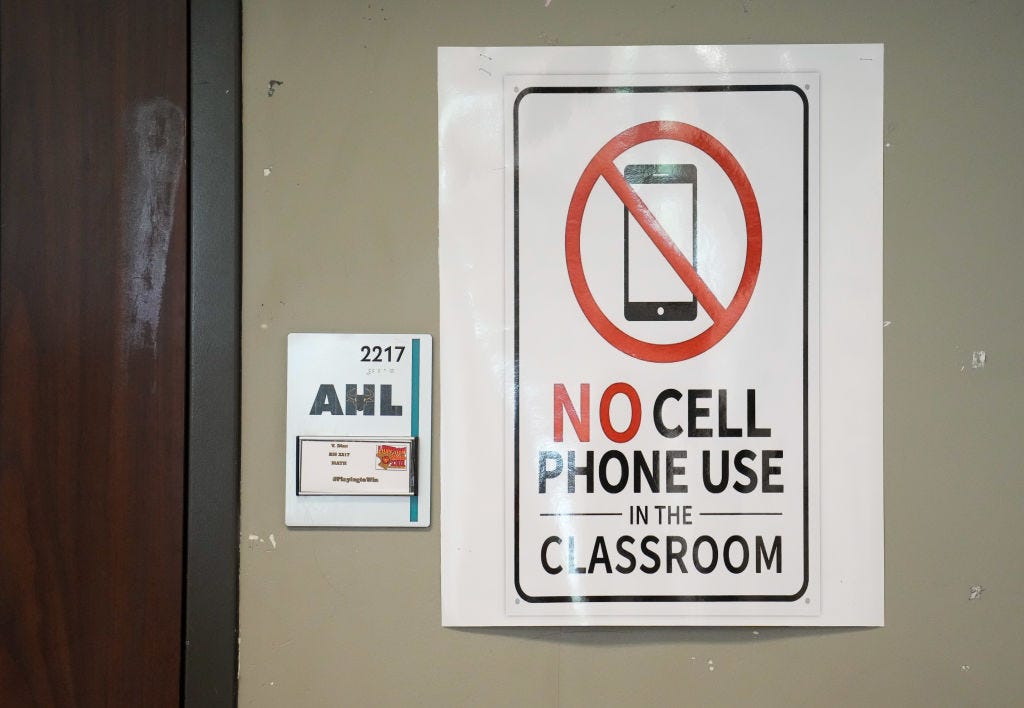
When I started this column late last year, one of the first studies I dug into was an analysis of a school phone ban in Florida. Some topics never go away for long. The most-discussed research this week again focused on screen time, kids, and related school policies.
First, our friends over at the Institute for Family Studies put out striking new survey results. The gist is that today’s kids have a lot of access to screens, but relatively little freedom in the real world. One indicator: by the age of 11, over 60 percent of kids have a smartphone, but around half still can’t leave the family’s property unaccompanied.
Meanwhile, a new working paper released through the National Bureau of Economic Research may provide the most rigorous assessment of school cell-phone policies yet—and it doubles as a bit of a Rorschach test, with results that lend themselves to varying interpretations.
As a certified screen-time hater (just ask my kids), I thought two findings in particular stood out. First, when schools aggressively lock down kids’ cell phones, teachers report seeing far less personal use of those devices during class—which in my view justifies such a policy all by itself, as kids obviously should not be messing around with their phones in class. And two, students’ overall wellbeing dips a little as they get used to the policy and then actually improves.
On the other hand, the researchers find only minimal effects on academic performance and student behavior—results some find a bit underwhelming.
Let’s back up and dig into the methods here.
Basically, a company called Yondr makes pouches that schools can use to contain their cell phone problems. The pouches lock magnetically, though they don’t block signals. Students can keep their (hopefully silenced) phones with them in these pouches without being able to use them, and they can unlock the pouches at dedicated stations in emergencies or when they go home. This stops short of a full-on ban while avoiding some of the enforcement problems inherent in, for example, a “no show” policy, where students carry their phones on them but officially are not allowed to take them out.
The authors have data on which schools throughout the country have purchased this product. On top of that, they have a wide variety of testing and administrative data about the schools, and they ran surveys of both teachers and students to track other policy changes and outcomes. This allows them to compare trends in schools that adopted these pouches with what happened at other, similar schools.
Student cell-phone distraction clearly fell. In their teacher survey, educators at Yondr schools estimated that in-class cell phone use for personal reasons fell from 61 percent of students to 13 percent following the change, though these are subjective guesses (and schools that made other policy changes also saw declines, if smaller ones). Phone “pings” recorded in schools fell too, by around 30 percent, but this includes the phones of teachers and staff, and phones can generate pings even from inside the pouches, making that a lower bound for the reduction in student cell-phone use.
Other outcomes, though, have more mixed results. As mentioned above, student wellbeing—measured through an index of self-reported positive and negative feelings—dips at first but ultimately rises, suggesting some admittedly modest long-term benefits to the policy. The authors peg the boost at 0.16 standard deviations in the second year after adoption, which implies the median kid, at the 50th percentile of wellbeing, would improve to what used to be the 56th percentile.
Meanwhile, the test-score results are small and inconsistent, with a possible increase for high school scores (especially math) and a possible decrease in middle school. Disciplinary incidents see a short-term increase, presumably reflecting an adjustment to the new rules, but this fades out. The authors report “little evidence of effects on school attendance, self-reported classroom attention, or perceived online bullying.”
A miracle cure for everything that ails American education? No. But a worthy policy change? Looks like it to me.
From the Manhattan Institute
Immigrant assimilation leads to lower marriage rates, writes Daniel Di Martino.
Other Work of Note
Another study on kids and social media, asking why Australia’s youth social-media ban hasn’t been very effective.
“This paper argues that smartphones changed how teens spend time with each other, and that this change in turn drove the collapse in teen fertility.” Also, do parents who divorce reduce their kids’ later fertility?
Remember the famous political-science finding that public policy is almost totally unresponsive to the opinions of anyone but the rich? This paper says it’s driven by a subtle statistical problem.
Some new modeling of what might happen if we taxed married people based on their individual- rather than couple-level earnings, an idea near and dear to my heart.
“[R]esidential segregation … accounts for more than one third of marital sorting by class but less than 5% by race.”
“We find that human capital at high school completion largely determines racial and ethnic differences in mid-life labor market outcomes, explaining up to 87% of gaps in some outcomes.”
Who’s allowed to self-identify as black?
Beth Akers on how to ensure colleges provide value. And which colleges face the highest stress from demographic and other new challenges?
Some interesting history on how constitutional amendments have worked historically, focused on the question of whether the Equal Rights Amendment is now law despite missing its deadline years ago.
Males’ pot use has hit all-time, er, highs.
ICE arrests do not actually seem to spark much political action, at least in terms of voter registration and donations. And this study probes the effect on the labor market.
New analysis of gunshot-detection technology in Detroit. The results suggest a decrease in violent crime, but also an (odd) increase in property crime, lots more work for cops, and no change in clearance rates. See also my report from last year summarizing research on the technology.
Detailed analysis of a century’s worth of suicide data.
Using genetic data to help chart kids’ cognitive development.
How the CBO estimates the budget effects of tariffs.
Measuring corporate taxes’ effects on firms’ financial distress.
What do hospitals accomplish by hiring management consultants?
Some results from a survey on “political breakups,” where people end relationships or friendships over politics. More than a third of people have experienced one, and Democrats seem more likely to initiate one.
“Evolvable AI: Threats of a new major transition in evolution.” And how the AI industry could regulate itself.
Wind turbines don’t seem to affect the health of those living close by.
Hate it all you want, but mandatory two-factor authentication seems to reduce fraud.