


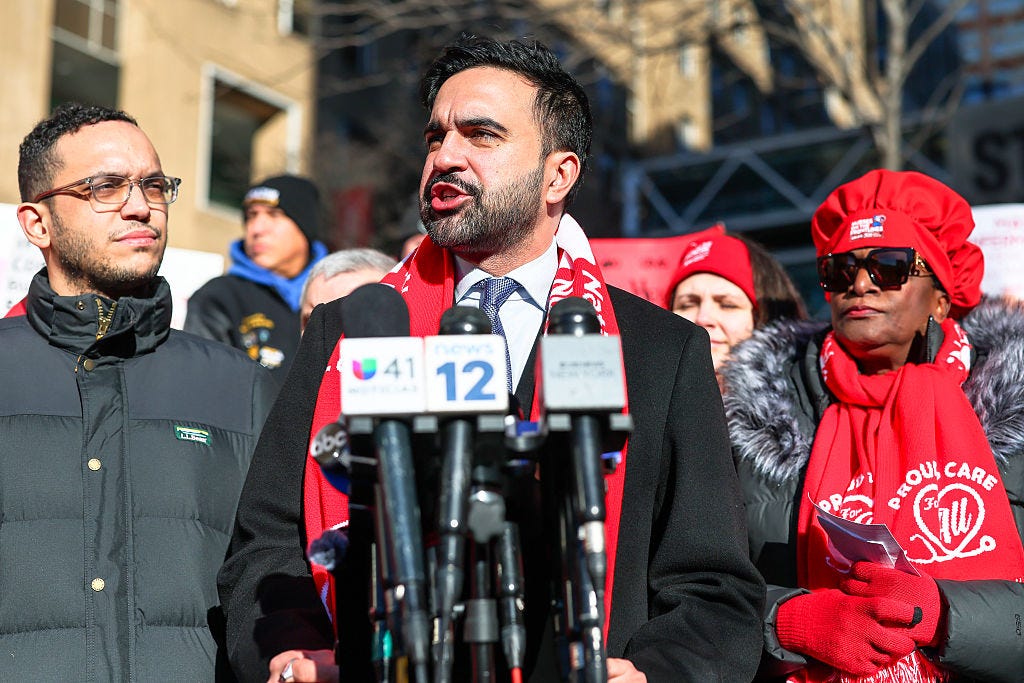
On Sunday, New York City Mayor Zohran Mamdani spoke at a rally for the launch of Union Now, a new organization aimed at expanding organized labor’s reach. It’s the latest in a series of early pro-union moves by the mayor, including joining a nurses’ strike picket line and pushing to unionize tenants.
Mamdani’s approach is misguided. Competition, not unionization, is the surer path to improving conditions for both workers and tenants. In fact, more unions will mainly accomplish one “goal”: consolidating political support for policies that ultimately make the affordability crisis worse.
It is well established that labor unions—which secure exclusive bargaining rights over workers’ terms of employment—can raise wages for their members relative to what they would otherwise have been paid. But unless matched by increases in productivity, the gains amount to rent seeking, extracting benefits without greater output. A 2025 National Bureau of Economic Research study, for example, found that most of the wage gap between unionized and nonunionized workers reflect unions’ ability to extract more rents for workers, rather than underlying productivity differences.
Who bears these costs? At Sunday’s rally, Sara Nelson, president of the Association of Flight Attendants-CWA, suggested they fall largely on management and corporate profits. “Too often, the boss has all the power to starve workers during a fight,” she said. “Union Now will work with unions directly to ensure workers have the means to win.”
In reality, the burden is often more diffuse. In highly competitive industries, where firms have limited ability to pass on higher labor costs, those higher costs might indeed take the form of lower profits. A 2011 study estimates that, if the entire economy were unionized, profits would fall by 20 percent.
But that is not necessarily a win for workers. Lower expected profits tend to reduce investment, slow business formation, and push jobs to places where compensation more closely reflects productivity (or offshores them entirely). A 2025 Mercatus Center study of the Rust Belt echoes this pattern, finding that “[u]nions wielding monopoly privileges and fueling strikes and labor conflicts were responsible for 55 percent of the region’s decline in US manufacturing employment.”
For poorer workers, the effect is especially pronounced. Unions’ use of coercive power to extract higher wages for existing workers comes at the expense of outsiders who might otherwise have worked for less. The result is higher unemployment and fewer opportunities. Empirical data show that private-sector job growth in right-to-work states has been far more robust than in non-right-to-work states.
Then there’s the other side of the equation: since only a portion of union-driven cost increases comes out of profits, much of the rest is borne by consumers in the form of higher prices. And since most people are both workers and consumers, higher wages are often offset by higher prices.
A more promising approach is to encourage competition. Moving away from New York’s union-dominated labor markets—through policies like right-to-work laws, which eliminate mandatory union membership—aligns wages more closely with productivity and expands opportunities for workers. Just as important, it lowers costs for consumers by reducing the upward pressure on prices.
The benefits show up in investment and job creation. States with more flexible labor markets tend to attract more business investment, which in turn drives employment growth. The job security unions provide—making it harder to dismiss workers—is real for those inside the system. But a more dynamic labor market offers a different kind of security: the ability to find new opportunities quickly, often on terms that exceed standardized union contracts.
Right-to-work laws aren’t the only path forward for New York, though they would be a step in the right direction. The state ranks last on the Tax Foundation’s Competitiveness Index, and the group’s 2026 report outlines several ways to improve that standing. Fully repealing New York’s capital stock tax, allowing full expensing of investments in machinery and equipment, and cutting corporate taxes are just a few sensible measures the state could adopt to expand investment and give workers more options.
While unions fall short as an economic solution to New York’s affordability crisis, they have nonetheless proven effective as a political force. That helps explain Mamdani’s emphasis on expanding them. But for New Yorkers concerned with rising costs, the priority should be on policies that increase competition, attract investment, and expand opportunity rather than on merely redistributing a shrinking pie.
While lefties are too dismissive of the importance of a big pie and the role economic freedom plays in that, the economic laissez-faire people are too dismissive of the problems of a winner-take-all economy and not having some baseline public goods. I too think unions are a bad way to ease the winner-take-all tendencies of our economic system, but libertarians also don’t seem to want progressive taxation or public goods that are provided better publicly and universally. They seem to think that people take their ball and go home if they can’t get infinitely rich rather than just being allowed to win “I am richer than you” rank order status pissing contests.
Probably need a balance of both, competition and unions, plus free markets, small-scale capitalism, and liberal democracy-based governance.