


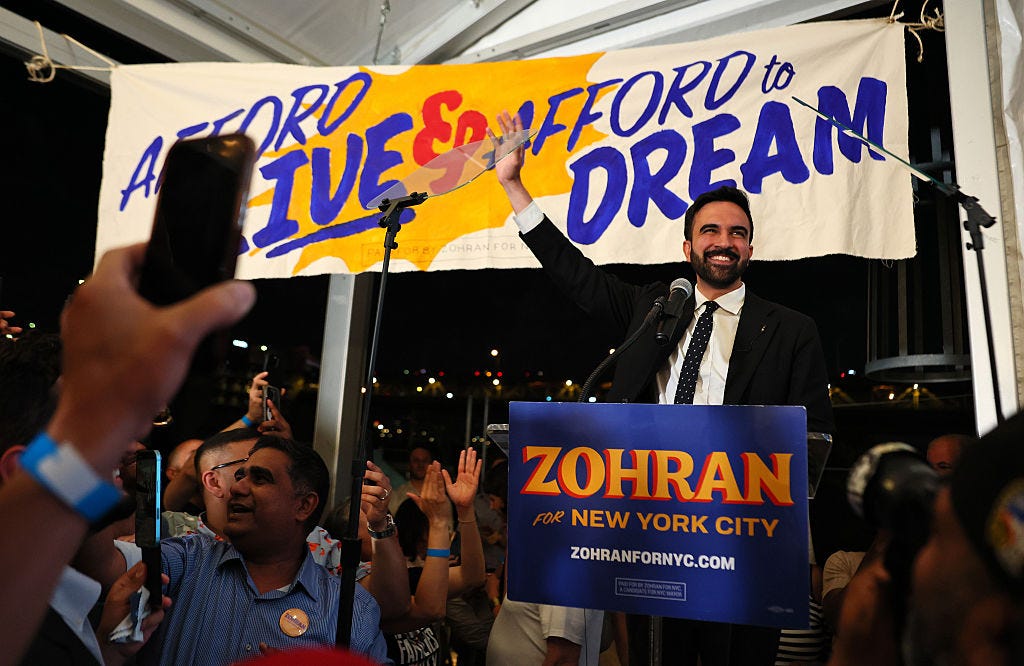
After winning the New York City mayoral election last November, Zohran Mamdani invoked one of former New York governor Mario Cuomo’s famous sayings. “While you campaign in poetry, you govern in prose,” Mamdani said in his victory speech. The line captures a basic reality of executive office: the mayor must make fiscal and managerial tradeoffs that candidates can evade.
Mamdani is already confronting that reality. Since taking office, he has retreated from at least two campaign commitments: expanding access to CityFHEPS housing vouchers and providing $10,000 payments to Department of Education paraprofessionals. Both proposals threatened to weaken the mayor’s control over spending and labor relations by allowing the City Council to impose obligations outside the mayor-driven processes meant to reconcile such commitments with the city budget.
The episodes say less about Mamdani than about New York’s strong-mayor form of government, which gives the sitting officeholder powerful incentives to defend executive authority. Had he allowed either Council incursion to stand, he would have weakened his own authority and that of his successors. His reversals are not yet evidence of a broader commitment to fiscal discipline or public-workforce reform.
During the 2025 campaign, Mamdani supported legislation that would give paraprofessionals $10,000 payments to augment their salaries, which start at roughly $33,000. After taking office, the Council passed the measure, which is estimated to cost $325 million. Mamdani, however, neither signed nor vetoed it, allowing it to become law without his signature. His administration then immediately went to court to block it.
Paraprofessionals’ low compensation deserves attention at the bargaining table. But that’s where it belongs—not in standalone legislation. Prompted by the United Federation of Teachers (UFT), the Council’s legislation attempts to use paras’ low pay as a pretense to undermine the limits of the state’s collective-bargaining law.
While public-sector collective bargaining is deeply flawed, it at least forces the mayor and union leaders to negotiate wages, work rules, and benefits simultaneously. That structure makes sense because the mayor bears ultimate responsibility for managing the public workforce and balancing the city budget, with personnel costs accounting for roughly half of spending.
The UFT represents both teachers and paras. During the last round of collective bargaining, union leadership chose not to address paras’ low pay, as doing so would have left less money available for teachers. Its members—including paras—nonetheless voted overwhelmingly to approve the deal.
If the UFT-Council legislation is allowed to stand, it would mean that a union representing multiple categories of employees could favor its larger constituencies (teachers) at the bargaining table, then turn to the Council to secure additional compensation for groups that received less (paraprofessionals). The resulting competition between Council and mayor to spend more would make responsible labor negotiations nearly impossible. Neither branch would want to be seen as the stingier one, and unions could play them against each other to secure higher pay without concessions on productivity or accountability.
Mamdani likewise made an about-face on CityFHEPS housing vouchers, the city’s rental-assistance program for low-income New Yorkers in shelters or at risk of homelessness. In 2023, the Council voted to expand the already expensive and unsustainable program through a series of local laws—outside the annual budget process through which the mayor and Council weigh competing spending priorities. Irresponsibly, the legislation imposed no cap on the number of vouchers and provided no appropriation to fund the expansion.
Former mayor Eric Adams vetoed the legislation, which the Council overrode. Adams then refused to enforce the law, prompting the Legal Aid Society and City Council to sue to force him to implement the expansion.
Candidate Mamdani promised to drop the lawsuit and expand CityFHEPS. As mayor, however, he continued the lawsuit and fought the Council in the final days of budget negotiations to halt further expansion. Ultimately, he and the Council agreed to drop the lawsuit in exchange for creating a new voucher program with a spending cap.
In both cases, the Council bypassed established mechanisms for reconciling new spending commitments with the city’s existing obligations. But Mamdani’s response does not necessarily demonstrate a commitment to fiscal discipline or workforce reform. If anything, the chicanery around his first budget and his chronic aversion to the label of austerity suggests that he intends to tax and spend to the city’s limits. His recent asking of agency leaders to find 2.5 percent in “savings,” rather than cutting their budgets, reveals his squeamishness around cuts.
As my Manhattan Institute colleague Nicole Gelinas has argued, Mamdani has mostly governed thus far like a standard progressive mayor, slightly to Bill de Blasio’s left. Through that lens, it’s not surprising that he’d reverse two careless campaign promises upon taking possession of City Hall, nor that he would seek to avoid layoffs at all costs.
If Mamdani wants to halt the Council from encroaching on the mayor’s powers, he should address structural changes in a future Charter Revision Commission. Such a commission should adopt Manhattan Institute adjunct fellow E. J. McMahon’s 2024 recommendations, which would have prohibited any local law requiring additional city expenditures to take effect without a separate and distinct appropriation. McMahon, sensibly, would also require legislation costing at least $100 million when fully implemented to be matched by equivalent spending reductions, unless the mayor waives the requirement.
Whether Mamdani is committed to public-workforce reform will become clearer in the next round of collective bargaining. The contract with DC 37, the city’s largest public union, expires this November. As with his predecessors, Mamdani will face pressure to establish a generous wage pattern without demanding meaningful managerial or productivity concessions in return.
Unlike past mayors, however, Mamdani’s political position gives him unusual room to resist. Most big unions supported Andrew Cuomo in the 2025 Democratic mayoral primary, and Mamdani’s electoral coalition does not depend on public-sector labor. If Mamdani is sincere about reforming government around excellence, he would aggressively seek efficiency and productivity improvements. New York has historically reformed its government only when fiscal crisis made change unavoidable. Mamdani has an opportunity to show that a mayor can act before reaching that point.
For now, Mamdani has defended his powers, but whether he intends to use his position to advance big reforms remains an open question.
More from City Journal Substack
New York’s Uneven Crime Drop

Earlier this month, the NYPD announced the fewest shootings and murders recorded through the first seven months of the year in New York City’s history. This decline—years in the making and accelerating since Commissioner Jessica Tisch took the helm at One Police Plaza in 2024—represents a major accomplishment …
Mamdani’s Plan to Cut City Spending: Ask Workers Nicely

New York Mayor Zohran Mamdani is ordering city agencies to identify 2.5 percent in “savings” over the next two fiscal years and beyond. To facilitate these reductions in spending growth, he launched a voluntary “Workforce Savings and Efficiency Survey” last week inviting city employees to “identify opportu…
Free Child Care Won’t Keep Families in New York

This week, 2,000 New York families opened their inboxes to learn that their toddlers had won seats in the city’s first free childcare program for two-year-olds. “Their lives will change forever,” Governor Kathy Hochul said. The program, launched with $73 million in state funding, part of a $1.2 billion state increase f…