


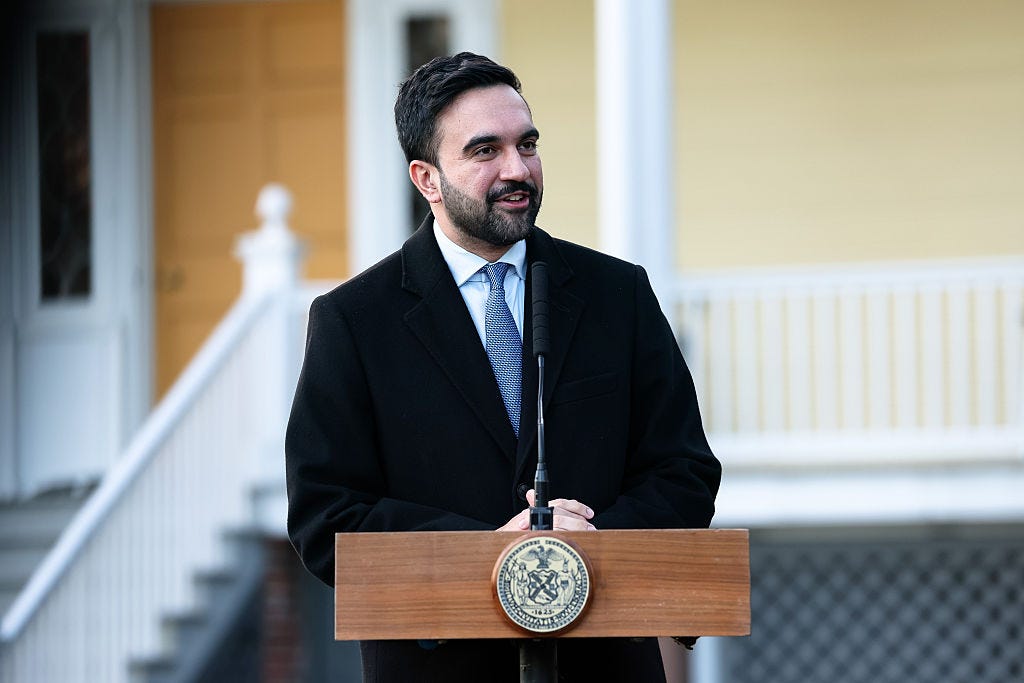
Zohran Mamdani’s first budget could have been a demonstration of competence. It gave the 35-year-old mayor of New York City a chance to show he can make hard decisions and manage the complexities of city government. Instead, it has become an amateurish spectacle of feigned surprise over “historic” underbudgeting about which budget watchers had long known, and calls for higher taxes—including a threat to increase property taxes by 9.5 percent across the five boroughs.
Now Mamdani is posting social-media videos portraying himself as a savvy budget cutter trying to fill a $5.4 billion deficit. In truth, he has yet to make meaningful tradeoffs or hard calls on a city budget that desperately needs both. Governor Kathy Hochul should force him to do so and resist his calls for new taxes, lest she enable even more fiscal irresponsibility in the future.
New York City’s economy is in a fragile state. Both its unemployment and inflation rates exceed the national average. Its businesses are choosing to expand operations in places like Miami or Dallas rather than within the city. Texas now has more finance jobs than New York. Excluding healthcare and social-assistance jobs, which are largely government-funded, the city lost 38,000 private jobs last year.
Yet thanks to the stock market’s boom over the last few years, the city and state governments have reaped unprecedented revenues, particularly from high earners. In a recent report, Manhattan Institute’s E.J. McMahon laid out how dependent the state has become on the top of its income base, with effective marginal income tax rates higher than ever before. Case in point: Mamdani’s budget gap shrank by about $5 billion after he accounted for Wall Street’s robust bonuses.
Unfortunately, New York’s lawmakers can’t help themselves from spending all of this—and more. Albany’s budgets are $30 billion higher today than they would be if spending had simply kept pace with inflation over the last decade, according to the Citizens Budget Commission. The state now finds itself, paradoxically, with a historically high level of reserves and a huge structural shortfall of $30 to $35 billion through 2030.
Mamdani knows all of this from his time as an assemblyman. But nobody expects a socialist to shrink government. So he’s leveraging that image to make it seem like his proposed $1.7 billion in cuts are some extraordinary measure to meet an extraordinary moment.
It’s an illusion. Mamdani has only approved around $200 million of the $1.7 billion in savings thus far. The rest still await approval. And many of the supposed savings are far from certain.
Consider the $100 million he expects to save by removing ineligible dependents from the city’s health-care plans. If his auditors don’t find the ineligible dependents, there won’t be anything to save.
Others are simply too little to matter. Mamdani says he will cut the city’s budget for pens and paper to claw back $27 million and direct his Department of Health and Mental Hygiene to buy the anti-overdose drug naloxone from a different vendor for another million in savings. That’s good, but small change compared to a $5.4 billion gap.
Worse, the full $1.7 billion in supposed savings is already baked into his $5.4 billion budget gap. If the cuts prove illusory, that gap will increase.
Meanwhile, Mamdani’s budget calls for more spending, including $3 billion more for the Department of Education, of which $1.6 billion will be used just to comply with Albany’s law to shrink public-school classes and hire more unionized teachers. Another $260 million is going to a new, two-person Mayor’s Office of Community Safety instead of closing the budget gap. Mamdani signed the city into a three-year, $1.86 billion contract with the hotel industry to provide shelter for migrants and homeless people. Does that sound like a city cutting spending to the bone?
To bridge the gap, Mamdani has proposed raiding about $1 billion of city’s rainy day reserves, which are meant to buffer revenues in a major macroeconomic downturn or negative shock. Using them during relatively stable conditions leaves the city highly vulnerable if and when a recession occurs.
The mayor’s supposed budget crisis could be solved by simple measures like asking Albany to pause the state’s class-size and hiring mandate. Amid a large drop in enrollment since 2019, school funding should be tied to their student populations. The 330,000-person municipal workforce should also be trimmed over time to account for new labor-saving technologies.
Instead, Mamdani’s preferred solution—taxing high earners and corporations more—would make a bad economic situation worse. Business leaders like Steve Fulop, the recently installed head of the Partnership for New York City, are warning that tax hikes would lead to capital flight and a further weakening of the city’s competitiveness relative to the Sun Belt.
In recent weeks, multiple bond rating agencies have adjusted their outlook on the city’s bonds to negative, raising the risk that the city will have to pay significantly more to service its debt. One of the lessons of the fiscal dark days of the 1970s and ‘80s is that the capital markets impose the ultimate check on the mayor’s freedom of action. The city can’t function if the bond market refuses to absorb its debt.
Hochul cannot allow Mamdani to rely on tax increases to sidestep even straightforward spending cuts. Setting that precedent would invite even more irresponsible budgeting in the future—a dangerous prospect as the mayor will need billions for things like new labor contracts and implementing universal childcare. So far, Mamdani’s approach says that he’s perfectly happy to shirk those serious decisions and have taxpayers shoulder the burden instead.
So the same democratic playbook for running cities since the 1960s? Is this the warmth of collectivism?