

Minimum Wage Defenders Proven Wrong?
Concrete Evidence (June 22, 2026)

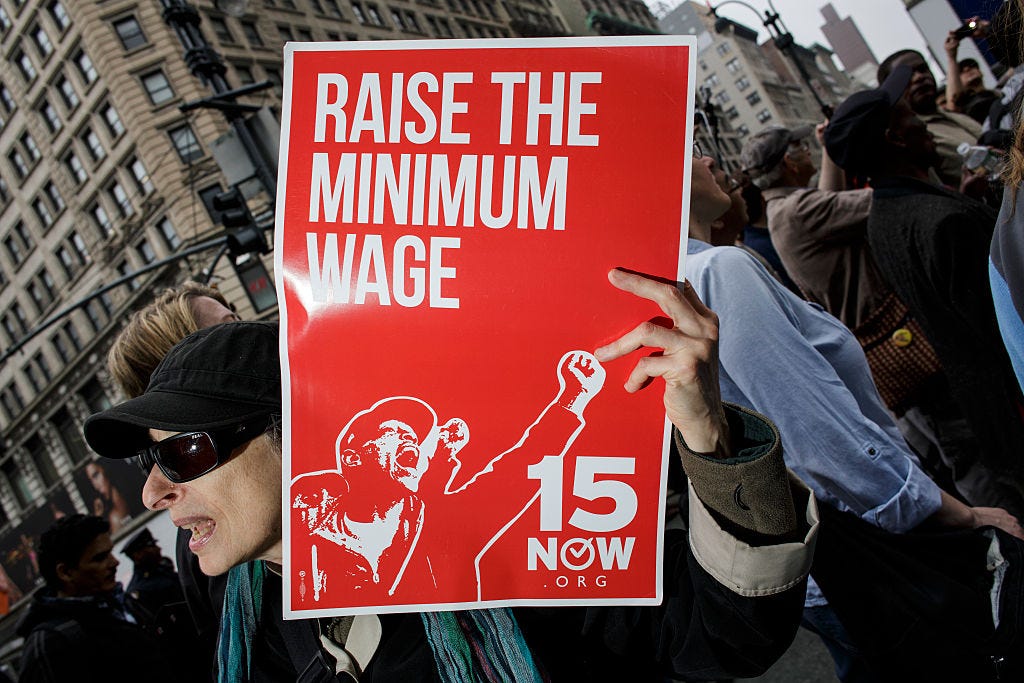
Economists have gone back and forth about the minimum wage for decades now. Basic supply and demand, not to mention common sense, would suggest it reduces employment: if employers have to pay more for labor, they’ll buy less of it.
There are skeptics, though, these days led by Arindrajit Dube of the University of Massachusetts-Amherst. If companies are exploiting their market power to underpay workers, these folks note, forcing higher wages won’t have the expected effects. Dube and his coauthors also say the facts are on their side: U.S. employment data reveal little to no impact of minimum-wage hikes, they’ve found in two recent studies, at least when analyzed with the most advanced statistical methods currently available.
A new working paper from David Neumark (a mainstay of minimum-wage research since the 1990s) and Antonio Rodriguez-Lopez pushes back. Dube’s sanguine findings, they say, are not the product of using spiffy new methods, but rather “are fragile and depend critically on a number of choices regarding variables, events, sample definitions, and weighting.”
The new paper includes an ungodly number of estimates that vary in size and statistical significance. But my eyeball generalization of their tables is that minimum-wage hikes reduce employment by around 1 percent on average, and by a bit more in the restaurant industry, where the employment reduction likely outweighs the higher wages earned by those remaining employed.
It’s an important paper that raises some intriguing issues, though it will certainly not be the final word.
Like much modern social science, minimum-wage research tends to compare what happened in a treated group (say, restaurant employees in a state that hiked its minimum wage) with trends in a control group (say, restaurant workers elsewhere). While this concept is straightforward, some technical issues have come to light with the methods economists have long used to put it into practice. I won’t go into the gory details, but a decent summary is here. Neumark and Rodriguez-Lopez take it as a given that, as Dube contends, it’s worth using updated methods that address these issues.
Any statistical method, however, will give different results if you change the data you feed into the model or the question you design the model to answer. And that’s where the new critique focuses. It’s a pretty technical paper, but I’ll highlight three of the biggest points of contention.
First, in one of his recent papers, Dube searched for employment effects in a specific slice of the wage distribution following state minimum-wage hikes, namely from $4 below the new minimum wage to $5 above it. The idea is that when the minimum wage goes up, employment below that new wage will obviously fall (because it’s now illegal!), but employment just above it will rise. If the fall in the former group is about equal to the increase in the latter, that implies the policy didn’t reduce total employment; it just shifted workers into the higher wage bins.
Neumark and Rodriguez-Lopez counter that if businesses close or shrink thanks to the minimum-wage hike, employment can fall even for better-paid workers—and they indeed find some such effects in the data.
The second major issue is that Dube measures employment relative to population, which changes over time. If a state hikes the minimum wage and then its population declines for unrelated reasons, obviously employment is going to decline—there are fewer people around, and you don’t want to blame the minimum wage for that. However, if people are leaving because the minimum-wage hike reduced their job opportunities or made life more expensive, those are effects you should want to measure rather than remove from the data.
Minimum-wage hikes may indeed coincide with population decline, the new paper finds—up to 1 percent, depending how it’s measured—making this distinction quite important. When Neumark and Rodriguez-Lopez measure employment without dividing it by a changing population denominator, the negative impact of the minimum wage appears much larger.
Third, the results seem pretty sensitive to whether states with bigger populations are given more weight in the analysis. California and New York appear to have suffered less from minimum-wage hikes than other states, perhaps because they are urban, wealthy parts of the country where even relatively high minimum wages are less binding. Removing these states or giving all states equal weight also leads to more negative estimates of minimum wage’s impact.
There’s been voluminous debate about the paper already (Dube’s X feed features some prominent criticisms). As further research comes out, I’ll be especially looking at two issues.
One of them is “pre-trends.” In other words, were the employment (and/or population) declines already happening in treated states well before the minimum-wage hikes went into effect? That would suggest these trends are not entirely caused by the minimum-wage hikes. The authors chart the effects they measure over time, finding this is an issue with only a few of their analyses, though economist Jonathan Roth has suggested the problem might be bigger than the charts in the study imply.
I’d also like to see a much deeper dive into the alleged population effect. Is it plausible that significant numbers of people move out when the minimum wage goes up? Is the exodus concentrated among folks who’d have those kinds of jobs? Do the states hiking minimum wages also tend to have other pressing problems, like housing costs, that workers might flee?
In a long-running literature where new studies drop all the time, it’s frustrating to realize there’s so much work still to be done.
From the Manhattan Institute
Charles Fain Lehman on why states shouldn’t chase revenue through sports betting.
Other Work of Note
Tallying welfare use among non-citizen households, by state.
The Great Recession clearly kicked off the U.S.’s fertility decline, though I think the bigger question of why births kept declining so long after.
Tons of new survey data from Pew about AI. And about parents’ work arrangements!
Predicting flu outbreaks with climate data.
“Patients treated with tirzepatide lost more weight than those treated with semaglutide.”
Do people move away from air pollution?
To become an academic economist, start by having statistically significant results in your job market paper.
Data dashboard: Which crimes get reported to the cops?
When are victims and witnesses most likely to participate in police investigations and prosecutions? And some new findings about progressive prosecutors.
Some data on women in police academies.
If you’re measuring racial disparities in traffic enforcement, don’t forget that not everyone pulled over in a given city actually lives there.
“The number of abortions remains higher than before Dobbs.” Yet, “abortion bans reduced gonorrhea rates by 21% among the population aged 15–44 and increased condom purchases by 5.4%.”
The decline in male labor-force participation (which I discussed previously here) seems partly driven by men’s experience with bad labor markets.
Can even one day together in the office a month improve performance for remote employees?
An idea to fund journalists who clean up government data they get through freedom-of-information requests.
Zoo animal populations are getting older.
Mental illness as a political identity?
Boys who are older than their classmates are more popular and more likely to have leadership roles as adults. And why do middle and high schoolers miss school?
“The conservatives we met believe democratic institutions have abandoned their own founding values.”
Are changes in college tuition driven by trends in state funding?
“The GI Bill widened racial inequality, doubling white veterans’ college completion while steering Black veterans into often-fraudulent vocational programs with no earnings returns.”
If you want to persuade your fellow citizens, try to “bridge identity divides through perspective-taking and personal narratives.”
Beyond the deaths, places that suffered more from the opioid epidemic had a lot of out-migration.