

New York Needs Open Primaries
Closed primaries let low-turnout races shape the politics of America’s largest city.

In New York City, the election that matters most usually happens before November. In a city where one party dominates most districts, the primary is often the only meaningful contest.
Last month’s congressional primaries, in which several Democratic Socialist candidates won Democratic nominations amid low turnout, suggest that this reality is continuing to push city and federal politics further left than the median voter might like. But that outcome is not inevitable. An open primary, which allows voters of any affiliation to vote in the primary of their choice, would make New York’s primary elections more competitive. By forcing candidates to appeal to a larger and more representative electorate, such a system would likely produce candidates more responsive to the city as a whole.
In a deep-blue city like New York, candidates who win the Democratic nomination usually go on to win the seat. This holds true even when accounting for New York’s fusion-voting system, which allows multiple parties to endorse the same candidate. My analysis of New York City Council races between 2013 and 2025 found that candidates who secured the Democratic nomination went on to win the general election 91 percent of the time.
Nor are these primaries particularly competitive, as turnout in is usually quite low. Between 2013 and 2025, just 21 percent of registered Democrats voted in primaries for New York City Council races, according to my analysis. In mayoral primaries, the figure was 24 percent.
That trend has shown up in other races. Turnout in New York’s recent congressional primaries, including the races won by three candidates endorsed by Mayor Zohran Mamdani, averaged just 17.2 percent of eligible Democrats. Even last year’s 2025 mayoral primary between Mamdani and Andrew Cuomo had just a 32 percent turnout—the highest in recent years. The 573,169 votes cast for Mamdani represented just 10.8 percent of the city’s 5.3 million eligible voters.
This means that a relatively small and unrepresentative share of the city’s electorate exercises enormous influence over who governs them. The voters who participate tend to be those for whom politics is especially high stakes. Some have direct material interests in city government, including public-sector unions and other organized groups. Others are motivated by ideology, as with the Democratic Socialists of America and similar activist organizations.
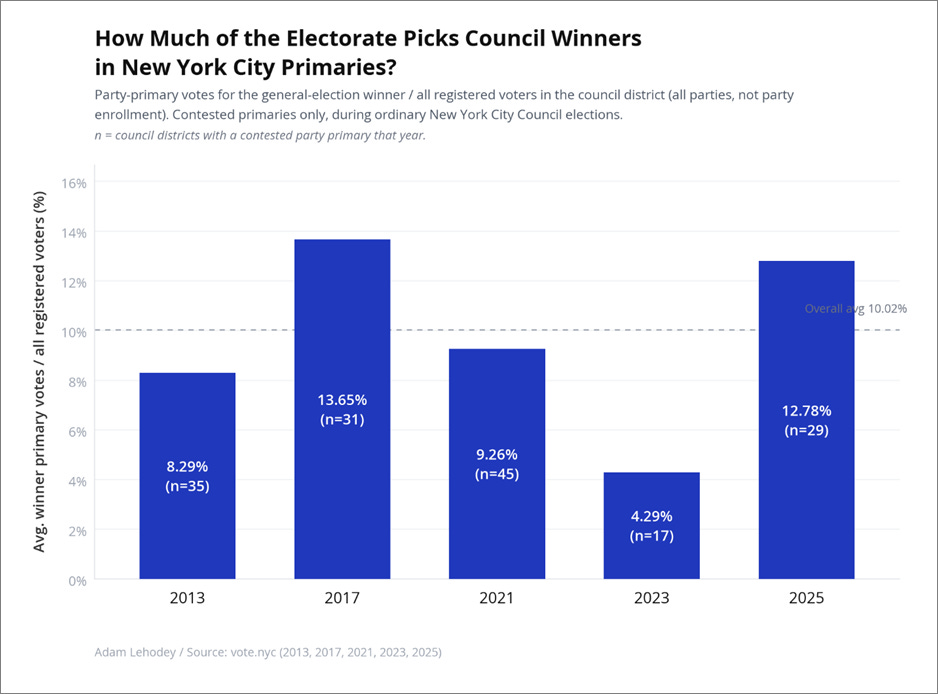
Whatever their motivations, those who turn out in low-participation primaries wield significant influence over New York’s politics. The chart below shows the number of primary votes received by eventual general-election winners in City Council races as a share of all registered voters in the district. In many cases, the candidate ultimately elected secured the decisive mandate from roughly one-tenth of eligible voters.
Open primaries would change the incentives facing candidates. A candidate seeking office would have to appeal to a broader cross-section of voters—not only to the smaller group most likely to participate in closed, low-turnout party primaries.
That would likely make local elections more competitive. Incumbents would face a broader electorate when defending their records, and challengers would have a stronger incentive to build coalitions beyond party activists and organized interest groups. Candidates with ambitious or unconventional platforms would have to persuade more voters that their ideas are workable.
The politics of reform are difficult. As my colleague John Ketcham wrote last year, New York City’s 2024 Charter Revision Commission considered, but ultimately declined to advance, a proposal that would have allowed voters to decide whether to open the city’s primary elections. The proposal drew support from good-government advocates and others who argued that closed primaries exclude too many New Yorkers from meaningful participation in local elections. But it also faced opposition from party leaders and incumbents who benefit from the current system.
Of course, incumbents have little reason to make reelection more competitive. Organized groups that perform well in low-turnout primaries also have little reason to broaden the electorate. That helps explain why open-primary proposals have repeatedly failed to make it onto the ballot.
But the issue is not going away. A Charter Revision Commission assembled by former mayor Eric Adams on his final day in office is now fighting in court to ensure that an open-primary measure appears on the November 2026 ballot.
Separately, voters have the ability to amend the charter via petition if a certain number of signatures are reached. A group called Unite New York has cleared the first hurdle of getting a bill that would allow open primaries to be introduced to the City Council. If the City Council does not adopt the proposal, the group can gather a second round of signatures to force the question onto the ballot.
New Yorkers should get the chance to decide whether to switch to open primaries. The city’s current system allows too many consequential elections to be decided by too few voters. Opening primaries would make the city’s elections more competitive and more representative. In a city where the primary is often the election that counts, more New Yorkers should be allowed to count.
I usually like City-Journal and agree with the premise but I do wonder: do open primaries really make a difference?
Plenty of states, like Illinois and Colorado, have open primaries and it hasn’t stopped radicals from getting elected. If anything, open primaries can open the door for DSA cadres who refuse to register as Democrats to vote en masse for far left socialists.
Of course, the solution is for moderates and center-right New York politicians to govern with a spine. But we all know how likely that is to happen.