

New York’s War on Compute
Albany’s proposed data-center moratorium would make the state even less competitive in the AI economy.

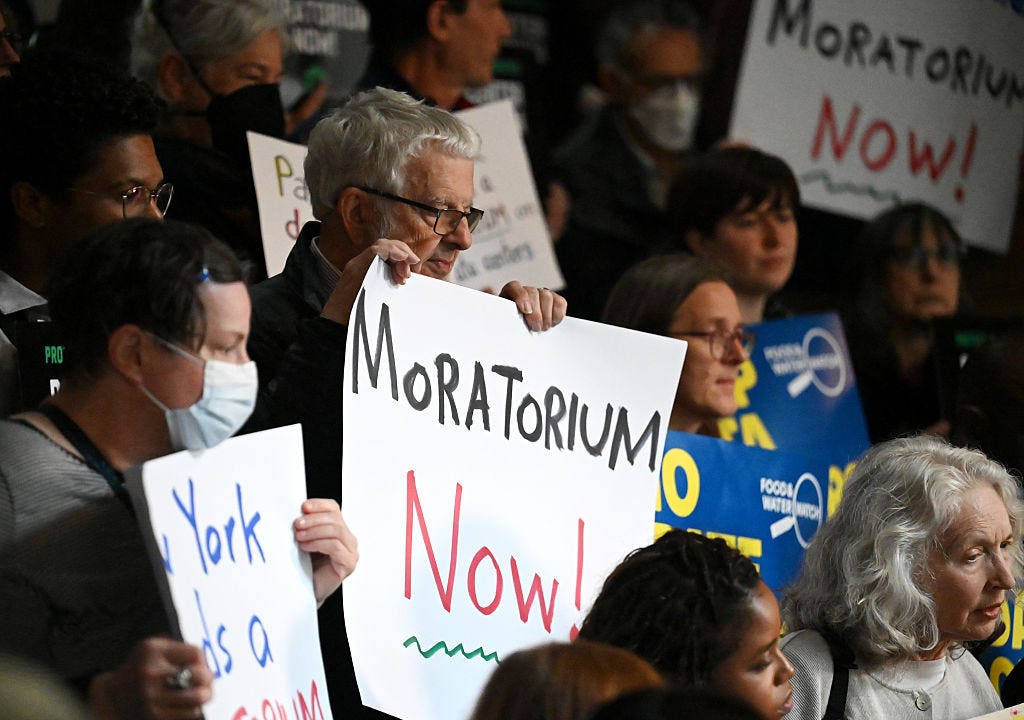
Earlier this month, Albany lawmakers approved what could become the first statewide moratorium on large data center construction. The bill, now on Governor Hochul’s desk, has been cast by supporters as a prudent response to rising electricity prices and the energy demands of a fast-growing industry. In reality, it’s the latest in a series of self-inflicted competitive wounds, the cumulative cost of which New York’s political class has yet to confront.
For decades, a jurisdiction’s economic competitiveness has depended on a familiar set of factors: its tax burden, regulatory environment, labor market flexibility, and transportation infrastructure. These factors shape where businesses invest, where workers relocate, and where economic activity compounds over time.
The AI economy adds another factor: compute capacity. New York has spent years making itself less competitive on the old metrics. Now Albany appears determined to fall behind on the new one too.
Sam Altman, the chief executive of OpenAI, has called compute “the currency of the future” and “maybe the most precious commodity in the world.” The January 2026 Council of Economic Advisers report similarly identified compute capacity as a key source of competitive advantage in an AI economy. It warned that the technology could produce a divergence in international growth analogous to earlier industrial transitions. And a recent Carnegie Endowment analysis put it even more bluntly: compute is “the one and only physical basis” for AI development.
The United States currently dominates that base: a Federal Reserve analysis published last October found that the U.S. controls 74 percent of global high-end AI computing capacity, with China holding 14 percent and the entire European Union just 4.8 percent. The jurisdictions that host this infrastructure capture construction spending, jobs, and tax revenue. More importantly, they’re better positioned to attract the research activity, capital investment, and AI-intensive industries that will increasingly drive economic growth. Compute capacity is becoming part of the industrial base.
For most individual users this is invisible. Whether a data center is in New Jersey or Virginia makes no meaningful difference to someone prompting an AI application from a Manhattan office.
The most important users of compute, however, aren’t individual consumers. They’re institutions operating at scale: AI developers, research universities, pharmaceutical firms, engineering companies, and financial institutions increasingly deploying AI across research, modeling, and analytics functions. For these organizations, compute resembles electricity itself—a foundational input whose availability and cost shape investment decisions at the margin.
Physical proximity isn’t necessarily decisive, but jurisdictions that host compute infrastructure tend to attract the talent and investment that depend on it. The opposite is also true: jurisdictions that constrain compute supply will gradually become less attractive places to build the next generation of AI-intensive operations. The damage isn’t visible in any single decision, but it accumulates as future investments flow elsewhere.
Industry analysts tracking data-center site selection confirm that permitting environment, regulatory predictability, and grid access have become key determinants of where these facilities are located. New York’s moratorium weakens the state on all three.
The bill would impose a 12-month pause on large new data centers in the state. But in reality, it is far from a temporary pause. The moratorium also triggers an 18-month state-level environmental impact study on data centers as a project category and adds new costs such as prevailing wage mandates and on-site renewable energy rules for new data centers, on top of the existing permitting obligations that already apply to large projects in the state.
More fundamentally, the bill rests on a faulty premise. As my colleague Ken Girardin has argued, rising electricity costs are primarily the product of Albany’s own energy policies, including restrictions on new gas generation. Data centers have become convenient scapegoats for a problem the state largely created itself.
The geography of data-center investment shows just how misplaced Albany’s panic is. According to a recent Pew Research Center analysis, Virginia has 287 data centers in various stages of development, Texas has 170, and Georgia has 141. New York, by contrast, has just six planned facilities and 148 currently operating—the weakest growth pipeline among major states. Three-quarters of all planned U.S. data-center construction will occur in the South and Midwest.
These dynamics reflect policy choices about energy availability, permitting, and broader investment conditions—the same factors that have always shaped where the industrial base of each era gets built. The red state–blue state economic divergence of the past 15 years was built on precisely this kind of policy differentiation. States that cut taxes, streamlined regulations, and welcomed emerging industries attracted population, capital, and employment. States that raised taxes, imposed new regulatory costs, and treated new industries with suspicion saw the opposite.
New York’s own experience illustrates the point. The state carries the highest combined corporate tax rate in the nation at 17.44 percent, a top marginal income tax rate exceeding California’s, and employment growth over the past decade that has badly trailed lower-tax rivals like Austin, Dallas, and Raleigh. Compute infrastructure is now becoming the latest addition to the list of factors on which New York has simply priced itself out.
Economic competitiveness has long turned on familiar variables: taxes, regulation, labor markets, transportation, and energy. AI is adding another. Compute capacity is becoming a key determinant of where capital is invested, where innovation occurs, and where future industries are built. New York has chosen to make itself less competitive on that dimension too.
 | A guest post by
|
NY not for the first time has it precisely backwards: encouraging -- or at least not discouraging data centers and their accompanying employment and tax revenues -- is a hedge on AI. Any state or citizen worried about AI should be pro-data center. They're going somewhere either Texas or China. You cannot stop them. You can only stop yourself from benefiting from them.