


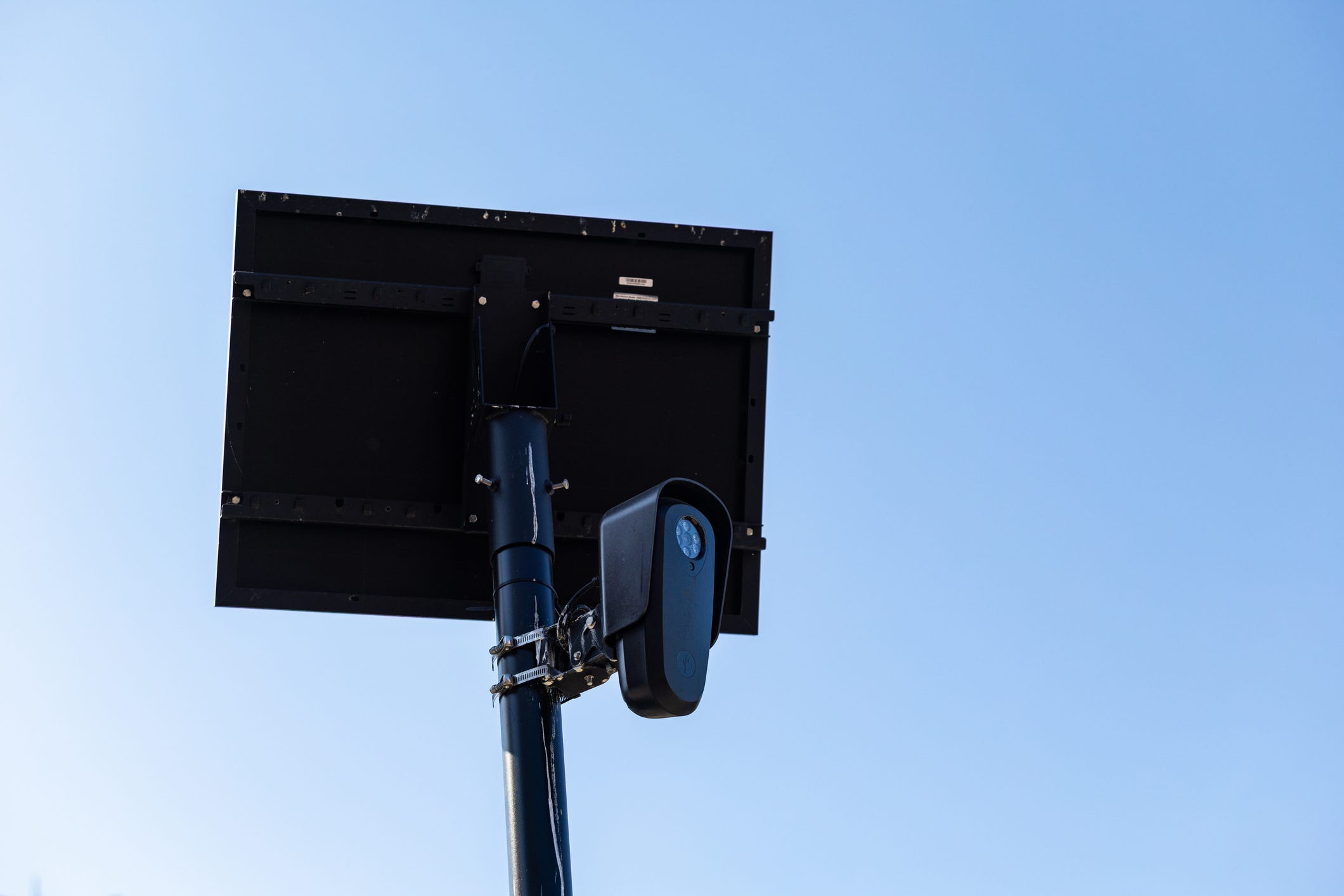
Tempe has dumped Flock. Arizona’s ninth biggest city announced last week that it had turned off the automatic license plate readers (ALPRs)—cameras that photograph and store records of license plates as they pass—that the company Flock Safety had operated for the city’s police department. Tempe didn’t do this because of a scandal: the city had found no evidence of misuse in its monthly audits. Nor was it because the ALPRs didn’t work: they were “helping officers solve crimes,” according to the city. Nor was it because Tempe’s network was particularly invasive: the city operates just 33 cameras to cover 1,200 miles of streets and queried its database only about once an hour.
So why did Tempe dump Flock? Councilmember Bobby Nichols—a member of the Democratic Socialists of America and self-described “champion for … local progressive activists fighting for equality, justice, and good governance”—said that ALPRs risked “infringing on residents’ civil liberties.” The city also cited stories of misuse in other Arizona cities, and other states entirely.
Maybe getting rid of a well-targeted, effective, scandal-free system over purely hypothetical concerns sounds reasonable to you. But to me, it sounds like a moral panic—the sort of collective freakout where we become convinced that something bad is pervasive and causing enormous harm, even when the actual harms are small or nonexistent. Such a panic about ALPRs, and Flock in particular, has swept social media in recent weeks, reversing public sentiment about them.
We should regulate ALPRs, just like any policing technology. But the Flock freak-out is pushing cities like Tempe to drop the cameras entirely. That’s bad for the people they’d otherwise protect—and for our culture’s ability to sensibly weigh costs and benefits.
Tempe is not alone. More than 140 cities have canceled ALPR contracts, according to a database assembled by the Institute for Justice, a libertarian law group currently suing several jurisdictions over their use of Flock cameras. While some of these cities may have carefully weighed costs and benefits, others have doubtless been swayed by the broader social media panic.
Nor are cities the only ones getting in on the action. Rep. Thomas Massie has pushed federal defunding of ALPRs, while Sen. Bernie Sanders is reportedly planning legislation to ban them. Sen. Josh Hawley has promised an investigation into Flock Safety. Florida and Texas governors Ron DeSantis and Greg Abbott are cutting off state support for the cameras; Pennsylvania Governor Josh Shapiro would like to do the same. Wild claims are flying online: Joe Rogan asserted that “hundreds of cops have been busted for stalking people,” while Tucker Carlson said Flock cameras are part of the “coming slave state.”
Then there’s the vandalism. One tracker counts more than 245 cameras destroyed nationwide, with more added daily. Some have tacitly or explicitly defended the sabotage. The Pacific Legal Foundation’s Amy Peikoff, for example, condemned property destruction—but only after calling the “outrage … understandable” and claiming that “all dystopian clichés—Orwell’s 1984, Rand’s Anthem, Bentham’s Panopticon—are apt” to describe Flock’s network. Reason’s J.D. Tuccille went further, calling the destruction of property “not necessarily morally wrong” and cheered the way in which the “saboteurs” were “getting government officials’ attention.”
This all might be proportional if abuse were widespread or if we actually were living in an Orwellian “slave state.” But it isn’t, and we’re not. A close examination of the evidence suggests we should be taking a calmer approach to the whole discussion.
Start with fears that ALPRs are being routinely used to stalk citizens or otherwise harm them. The Institute for Justice has assembled a database of what it calls “ALPR abuse.” It’s not obvious that every incident deserves to be included. For example, it lists a case in which city authorities in Millcreek, Utah, found and removed an unexplained Flock camera on city property—concerning, but not clearly “abuse.” Still, examining the database with the assistance of AI, I count 125 police officers who have been fired, arrested, or prosecuted for abusing access to ALPRs by stalking, sharing data without permission (often with immigration authorities), or engaging in other “misuse” or “non-law-enforcement use.”1
The ideal number of cases of abuse and misuse is zero. But in a world where normal human beings have access to police technology, that’s not going to happen. So we have to ask: how common is abuse, actually?
One way to estimate it is as a proportion: those 125 officers are part of agencies which collectively are staffed by nearly 25,000 officers. That implies the abusers are just half a percent of the officers within those agencies where the problem is bad enough to attract media attention.
Another way to get a sense of the frequency of abuse is to compare the number of reported incidents of abuse to the number of reported cases where ALPRs have helped solve or prevent a crime. As Richard Hanania has argued, the harms of one need to be weighed against the benefit of the other. I’ve built a database that tracks news stories about the police using Flock, just one brand of ALPR. So far I’ve found roughly 1,700—almost ten times the number of stories in the Institute for Justice’s database. If ALPRs help solve ten times as many cases as they generate instances of abuse, that seems relevant to our judgement of whether they generate a level of misconduct that merits dumping the tech altogether.
There are, of course, objections to these arguments. One is that there are more abuses of ALPRs than get reported. Critics will often insinuate that the true level is much higher. That may well be true, but insinuation isn’t evidence. And while looking hard does turn up more cases, doing so isn’t easy. The Washington Post, for example, found “dozens” of cops engaging in suspicious patterns of search—but only by going through records covering 240 million searches and nearly 6,600 agencies. There are probably more bad apples out there, but the challenge of finding them suggests that there aren’t a whole bushel.
Another objection has to do with counterfactuals. Some might argue that my list of Flock-involved cases doesn’t tell us that ALPRs really solve crimes—maybe cops would have solved the crime some other way without the camera. That’s true, but it’s also true of other abuses. Cops who engage in misconduct using ALPRs might have engaged in abuse some other way in the absence of the ALPR. Indeed, because ALPR systems like Flock’s monitor for abuse—the firm recently strengthened its automatic monitoring tools—bad cops might be being caught sooner than they would in the counterfactual without Flock.
Take, for example, deputy Michael Fultz of Brevard County, Florida. Fultz resigned from his position in disgrace last month after a series of actions came to light. One of these was using Flock to stalk his ex-girlfriend. But other alleged misconduct included “placing a gun in his ex-girlfriend’s mouth and pointing it at the back of her head during consensual sex acts … appearing to perform a ‘Nazi salute’ in a photograph captured shortly before he was hired as a deputy,” and several other alarming decisions.
Someone like Fultz would have engaged in misconduct even without the ALPR. Indeed, it’s possible he was caught sooner because the Flock system he used was audited, while his bedroom was not. Stories of ALPR abuse alone, in other words, are not enough to tell us if the cameras actually make cops more abusive overall.
As Ian Adams and Scott Mourtgos explained recently in City Journal, we have quasi-experimental evidence that accounts for the counterfactual problem when considering crime. Their study actually compares jurisdictions with and without ALPRs, before and after deployment, to truly estimate the effect of the cameras on crime. By contrast, we have no such evidence about ALPRs’ effects on the rate of abuse—just a cherrypicked list of stories. Arguing based on such weak evidence is typical of a moral panic.
For many people, the problem isn’t the abuse but rather the perceived risk ALPRs pose to privacy. Are Flock cameras the new tools of Big Brother? Such concerns are reasonable in the abstract—no one wants to live in a surveillance state. But ALPRs aren’t doing what many people seem to think they are.
ALPRs do what they say on the tin: read license plates. (Flock ALPRs also observe facts about the outside of the car, like make, model, color, and damage.) By virtue of that fact plus a time stamp, a license plate reader database measures that a given car was at a certain place at a certain time.
Importantly, the Supreme Court has been clear that there is no Fourth Amendment protection implicated in the mere act of observing license plates. There is no reasonable expectation of privacy as to the exterior of your vehicle, nor as to your movements in a car on public thoroughfares. This is so in part for reasons of investigative efficacy, but also to avoid the absurd conclusion that a police officer cannot look at traffic without a warrant.
Of course, while one ALPR can replace one cop, a network of 120,000 ALPRs could be a different beast. At what point does technology enable “mass surveillance” or a “dragnet”? The Supreme Court has recently distinguished the use of certain kinds of technological systems as per se searches because they implicate the “whole of [a person’s] physical movements” in a way that simply knowing where they were at a given time does not. Could ALPRs rise to this standard?
Maybe, but consider the kind of searches we’re talking about here. In one case, Carpenter v. United States, the Court was asked to evaluate “cell site location information” (CSLI)—the accumulated data on where a phone has been in relation to cell towers. In the other, Chatrie v. United States, the Court was interested in historical location data collected by Google, an even more granular source of a person’s historical movements. The data in both cases are extremely detailed—in Carpenter, the Court analogized CSLI to an ankle monitor the government attaches to the phone’s user, while in Chatrie it described location history as even more invasive. And the data do not stop being collected at the traditionally protected threshold of the user’s home or other private property. These unique features, the Court has said, make accessing this data into a search in a way that less sophisticated forms of surveillance are not.
That data, then, is not really like the data that ALPRs collect. While a cellphone is like an ankle monitor, ALPRs simply cannot observe most of people’s movements. By my estimate, for example, Flock’s 120,000 cameras cover less than 0.05 percent of all roads in the United States. As my colleague Rafael A. Mangual has noted, New York City deploys an enormous number of ALPRs, yet barely covers a fraction of a percent of its surface area with them. Moreover, unlike cellphone data, ALPRs do not sweep in private places—while your cellphone follows you into your home, an ALPR remains focused on the public thoroughfare.
This is all part of why, as Mangual has noted, appellate courts the nation over have repeatedly found that the use of ALPRs does not constitute a search for purposes of the Fourth Amendment. That may change, but doing so will require explaining when a “network” of ALPRs gets big enough to constitute mass surveillance. It seems hard to argue, for example, that Tempe’s 33 cameras really added up to a “dragnet.”
This argument is not just academic. Americans enjoy a vital right to be secure in our persons and property against unwarranted government intrusion. And it is reasonable to worry about the government blanketing our streets with cameras. But most ALPR deployments look more like Tempe’s—a handful of cameras dropped at strategic spots—than they do like mass surveillance. And such targeted systems not only don’t run afoul of our rights technically, but shouldn’t worry us substantively.
None of this means that we shouldn’t regulate these tools. Any technology in the hands of government requires careful management, regardless of actual evidence of abuse. It’s not panicking to ask for common-sense regulations like limits on data retention; strict criminal penalties for cops who abuse ALPRs in ways that harm others; logging standards and third-party audits conducted by state Inspectors General or equivalent; and prohibitions on ALPRs near sensitive places, like religious institutions or medical facilities. State legislatures can and should act on these priorities—not because there’s a big crisis, but because common sense commends them.
What we shouldn’t do, though, is ditch ALPRs altogether, because they help fight crime. Adams and Mourtgos’s research shows that rolling out ALPRs in a jurisdiction reduces motor vehicle thefts by 11 percent at least, with suggestive evidence of decline in property offenses more broadly. That’s consistent with other evidence, including high-quality evidence showing the crime-reducing effect of cameras generally, and weaker evidence that can be read as suggestive of ALPRs specifically reducing crime.
Those benefits are non-trivial. The total social cost of crime is on the order of trillions of dollars a year. Even a single motor-vehicle theft probably costs the victim and the criminal justice system on the order of $15,000 per incident.2 If Flock cameras, for example, cost $2,500 to $3,000 per year, then preventing even one theft is worth installing an extra five to six cameras on a cost-benefit basis. Tempe reported 405 motor-vehicle thefts to the FBI last year; if its ALPRs prevented just seven, they were worth it.
Some may still object that the cost of ALPRs should be counted in abuse and loss of liberty, too. But in reality, the tools seem to produce relatively little of either; to the extent that they do, sensible regulation can mitigate risks while preserving upsides. Such calm balancing of costs and benefits is the right way to handle the Flock conversation—not celebrating vandals or capitulating to a moral panic.
I did this analysis on August 28, 2026. The data may have changed since that time!
Using McCollister, French, and Fang 2010’s estimate and adjusting for inflation.
"This all might be proportional if abuse were widespread or if we actually were living in an Orwellian “slave state.” But it isn’t, and we’re not."
It was literally just a few years ago where leaving your house and freely breathing the air was illegal.
Sorry. Not buying your argument. And neither are many people and places. ALPRs sound great in theory. But there's pesky people involved. Who are documented in misusing these systems.