


From 1970 to 1990, America’s legal industry ballooned in size. This hardly went unnoticed.
Here at the Manhattan Institute, folks like Peter Huber (whom I posthumously profiled a few years back) and Walter Olson (now at the Cato Institute) were on the case, explaining how—and why—more and more conflicts were ending up in court. The lawyers themselves often proved the largest beneficiaries of what Olson, in a 1991 book, dubbed the “litigation explosion.”
A fascinating new working paper from economists Ariell Reshef and Cailin Slattery, armed with the benefit of several decades’ worth of hindsight and numerous large datasets, offers a look back—and a careful theory of what happened.
On X, Slattery calls the study “a paper about one figure,” which I’ve recreated below. It depicts the wages of lawyers relative to other private-sector workers, as well as the share of all private employment hours that the legal-services industry represented. Both skyrocketed in those pivotal two decades.
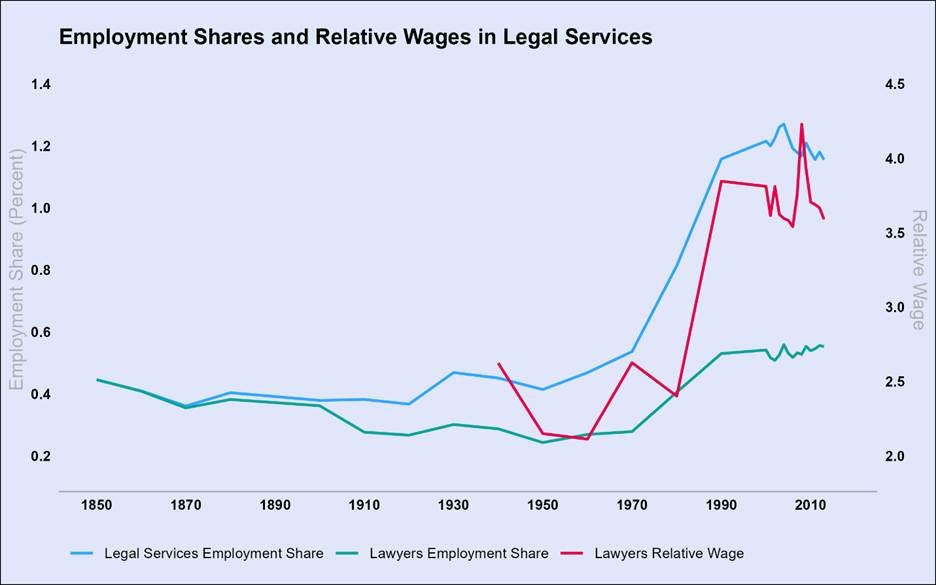
The demand for legal services obviously rose substantially. In the same period, lawyers became increasingly specialized.
The authors offer three major contributors to these trends. As they summarize:
First, an expansion in scope: a wave of legislation brought new domains of conduct within the reach of the law. Second, an increase in uncertainty: much of this legislation was written in broad, open-ended language, leaving contested questions to be settled in court. Third, a change in lawyers’ incentives: rather than expand public enforcement capacity, Congress enacted statutes to encourage enforcement by the private sector [including “fee shifting,” under which a losing defendant might have to pay the plaintiff’s legal fees].
The driving force here is a wave of major legislation that passed starting in the 1960s. Big-ticket federal examples included the civil-rights and voting acts of the 1960s, as well as the environmental, consumer-protection, and workplace-safety laws that soon followed. Even the deregulatory measures of the 1970s and 1980s often had the effect of shifting disputes into court as a substitute for direct regulation.
Not only is this narrative broadly familiar to those who know this period of history, but the authors document its contours empirically—such as by charting the rise of fee-shifting provisions in legislation and the growing page count of federal regulations, and showing that they statistically predict the rise of lawyers.
They also connect specific pieces of legislation, such as a 1975 fee-shifting law and the expansion of liability for employment discrimination enacted in 1991, to rising numbers of cases. And they show that new legislation can often be tied to higher lawyer employment right where you’d expect it: the 1964 Civil Rights Act, for example, corresponded to rising legal employment disproportionately in states with more black workers; the Clean Air Act may have had a similar effect in states with worse air quality.
Then they move on to state laws, where states that enact new rules can be compared against a control group of states that don’t—and the authors can look for effects in the specific fields of law affected. Laws heightening product liability seem to push lawyers into negligence and insurance law, while unilateral divorce pushes them into domestic law.
Reshef and Slattery also show that the supply of lawyers is tightly controlled and didn’t expand enough to meet the new demand. And they explore some competing explanations for that demand increase, finding them wanting. For example, changes in the country’s industry composition can explain only a fraction of the legal industry’s growth, and lawyers’ LSAT scores didn’t rise (implying they weren’t getting paid more simply because they were better).
In a more speculative exercise, they estimate the costs of the changed legal regime. For example, they find that legislative uncertainty—the fact that many laws are vague, taking as a given that they cover more conduct than they used to—cost the country more than $20 billion in 2024.
This is an extremely impressive undertaking, combining extensive data from numerous sources into a compelling story about the lawyerization of America. That transition has been complete for a third of a century, but we continue to live with the fallout.
From the Manhattan Institute
Chris Pope evaluates Maryland’s efforts to regulate hospitals’ fees and revenue.
A new survey from our polling team finds that the Democrats’ dominance in California exists alongside deep voter frustration.
Other Work of Note
“The federal budget deficit totaled $2.0 trillion in fiscal year 2026, CBO estimates, $218 billion more than the deficit recorded in fiscal year 2025.”
Evaluating theories of the 2000s housing crash.
Are prediction markets politically skewed?
Most influencers posting on health topics are actually medical professionals.
How long do college students take to earn degrees? And how much are Ph.D. students delegating their writing to AI?
The pandemic’s lasting impact on the labor force.
How kids help their peers in different cultures.
Young adults’ “happiness crash.”
Evidence against Tylenol use in pregnancy causing ADHD or autism.
Did the boost to SNAP during the pandemic drive a lot of spending on sugary foods? And another study of a similar intervention.
A new tool for analyzing legislation, applied to the One Big Beautiful Bill Act.
Did education boost political engagement on civil rights?
How much do hospitals “upcode” to get bigger reimbursements in California?
Some findings on Medicaid dental benefits in West Virginia.
Do ridesharing services reduce crime?
Mixed results for the effects of a student-support program on crime.
Judging efforts to predict sexual assault in prison.
Why most stereotypes are negative.
Does gaining citizenship improve immigrants’ economic mobility?
I’m skeptical. The big money is in corporate work, M&A, finance, and the like. Increasing the number of lawyers graduating from law school and admitted to the bar would have zero effect on the earnings of the corporate bar.
Did you know there are more students in law school than there are lawyers walking the Earth? We're coming out, guns blazing! … acquittal after acquittal after acquittal... until the stench of it reaches so high and far into heaven, it chokes the whole lot of them! — The Devil’s Advocate (1997)