


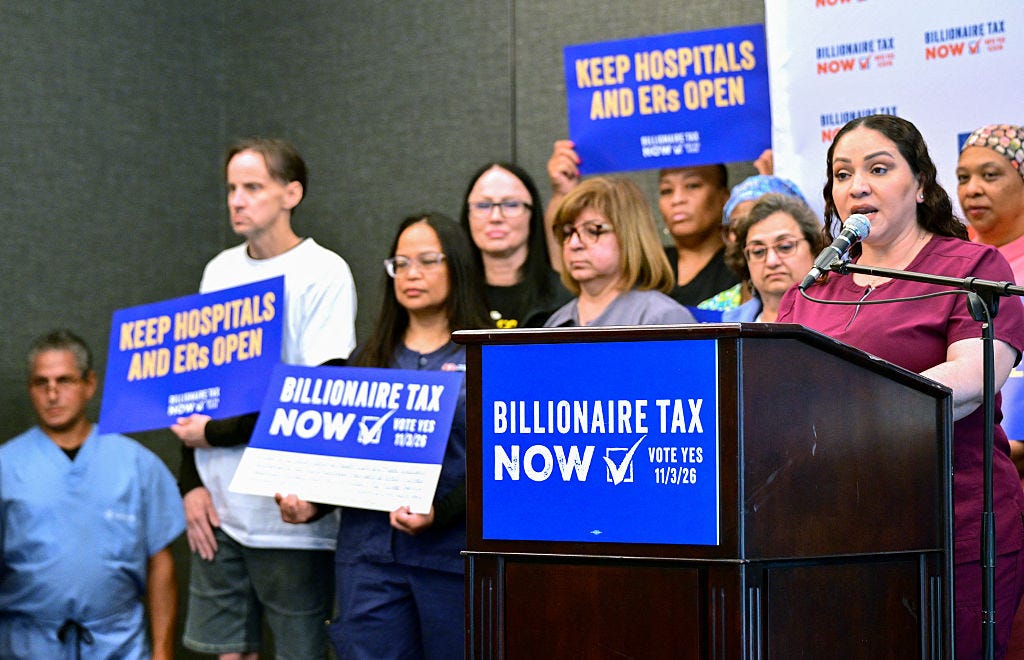
Next month, California voters will consider Proposition 40, a ballot initiative that would levy a one-time, 5 percent wealth tax on residents with a net worth above $1 billion. The measure, proposed by a major health-care workers union, has been the subject of fierce political debate. It also raises more fundamental economic questions about how wealth and investment gains should—or shouldn’t—be taxed.
The fundamental goal of tax policy should be to raise revenue while minimizing distortions to the economy or individual behavior. A wealth tax departs from the conventional approach to taxation: rather than waiting until an investor sells an appreciated asset, it taxes the value of the asset itself. A recent paper offers a compelling argument for why taxing wealth can be economically distortive—and how to best raise revenue without distorting the investment decisions that generate economic growth.
The paper, forthcoming in Econometrica, by economists Mark Aguiar, Benjamin Moll, and Florian Scheuer addresses a gap in traditional theories of taxation. Those theories often abstract away from changes in asset prices, even though stocks, homes, and other assets can rise or fall dramatically in value. Once those price movements are factored in, the researchers show that the distinction between owning wealth and realizing gains becomes crucial.
The researchers point to stocks as an example. If a stock price rises, the increase does not affect everyone the same way. Someone selling the stock benefits from the higher price, while someone buying it is worse off because it now costs more. Someone who simply holds the stock, meanwhile, has neither bought nor sold at the new price. A wealth tax ignores these distinctions.
To capture these differences, the authors develop a hypothetical taxation model that distinguishes among buyers, holders, and sellers. Rather than treating an increase in asset values as equivalent to an increase in economic well-being, the model asks who actually gains and who loses when prices change. The authors then discuss how a tax system can raise revenue without unnecessarily distorting these investment decisions.
Under the model, if an asset appreciates, sellers are taxed on their realized gains because they have more than before; buyers are subsidized for their realized losses because they need a transfer to recover their consumption before selling; and those who do not trade neither owe nor receive anything. The implication is that an optimal tax would fall on sellers who realize gains, rather than on everyone who happens to own an appreciating asset.
The wealth tax being discussed in California does not take into account these differences. It taxes individuals based on the value of the assets they own, not on whether they have actually benefited from the price movements that produced those valuations.
The researchers’ initial model is an idealized exercise in which governments can directly observe an individual’s economic welfare. Real-world tax systems cannot do that; they must rely on observable measures such as income, transactions, or wealth. When the researchers introduce this more realistic constraint, their model produces a somewhat counterintuitive finding about wealth taxes.
To see how, consider a wealthy family that owns a $1 million home but wants to move into a $2 million home. If housing prices double, the family appears to have become $1 million richer: its existing home is now worth $2 million. But the home it wants to buy now costs $4 million.
Because the family is a net buyer of housing, the increase in prices has actually made its desired move less affordable. The family is therefore hurt by the price increase even though they look richer on paper. Taxing them more at that moment, as a wealth tax would, moves resources in the wrong direction.
A capital gains tax on realized sales does not have this problem since it targets trades directly instead of using wealth as a proxy for who actually gained. The family trading up to a bigger house is selling a less expensive house and will be taxed less than the person selling the bigger house to this rising family.
This suggests another argument against wealth taxes. An appreciating asset means greater wealth on paper, but taxing that appreciation before the asset is sold can alter investors’ decisions about how much to save and invest. Waiting until gains are realized allows investments to mature before the government collects revenue from them.
The paper goes further by arguing that taxing every sale can also create distortions if the tax system ignores what the seller does next. It recommends evaluating buying and selling together within a certain window whenever possible.
Consider, again, the example of a family trading up to a larger house. The family has technically realized a gain when it sells its existing home. But it then puts all those proceeds, plus additional money, into a more expensive home. Then both transactions are considered, it’s clear the family has not cashed out its investment; rather, it has increased its investment in housing. Treating the initial sale in isolation would therefore obscure the actual economic realities of the family’s decision.
In other words, a tax system that recognizes net transactions can still allow greater freedom to reallocate capital while still collecting revenue when investors ultimately draw resources out of their investments.
That insight is relevant to California’s wealth-tax debate. Proposition 40 focuses on the current stock of wealth an individual has accumulated at a particular moment. This does not distinguish whether someone is realizing investment gains, accumulating additional assets, or simply holding an asset whose market price has risen. Those differences matter for promoting economic growth and investment.
The long-term effects that California’s wealth tax would have on innovation have been widely discussed. But even setting that issue aside, the proposal is problematic as a matter of basic tax design. There are better ways to raise tax revenue without distorting incentives and economic growth. If California wants to raise more revenue from wealthy households, the relevant question is not only how much to tax them, but what to tax and when.
Dario Marino is an economic policy fellow at the Manhattan Institute.
California Wealth Tax on billionaires / Proposition 40.
Facts:
California’s Proposition 40 proposes a one-time tax of 5% on the net worth of billionaires who lived in California onJanuary 1, 2026.
It would be due in 2027, though taxpayers could spread payments over five years for an additional charge. So the payments might be spread out, but it isn’t designed as an annual wealth tax.
If you’re not a billionaire, Proposition 40 would not tax your retirement fund or savings account.
The proposal targets billionaires who were California residents on January 1, 2026; pensions and retirement accounts are generally excluded even for those who are subject to it.
https://calmatters.org/politics/2026/10/california-billionaire-tax-explainer/
It's a really good paper. But it has a weakness that it does not directly discuss the situation we have.
In the end of the paper (section 6.3), the authors talk about sub-optimality of the step-up-basis at death, meaning this policy should be removed. But, since we have step-up-basis at death, the question should then be can wealth taxes in effect undo the step-up-basis.
I suppose it's hard to model this exactly, but that's the current situation the US is in.