


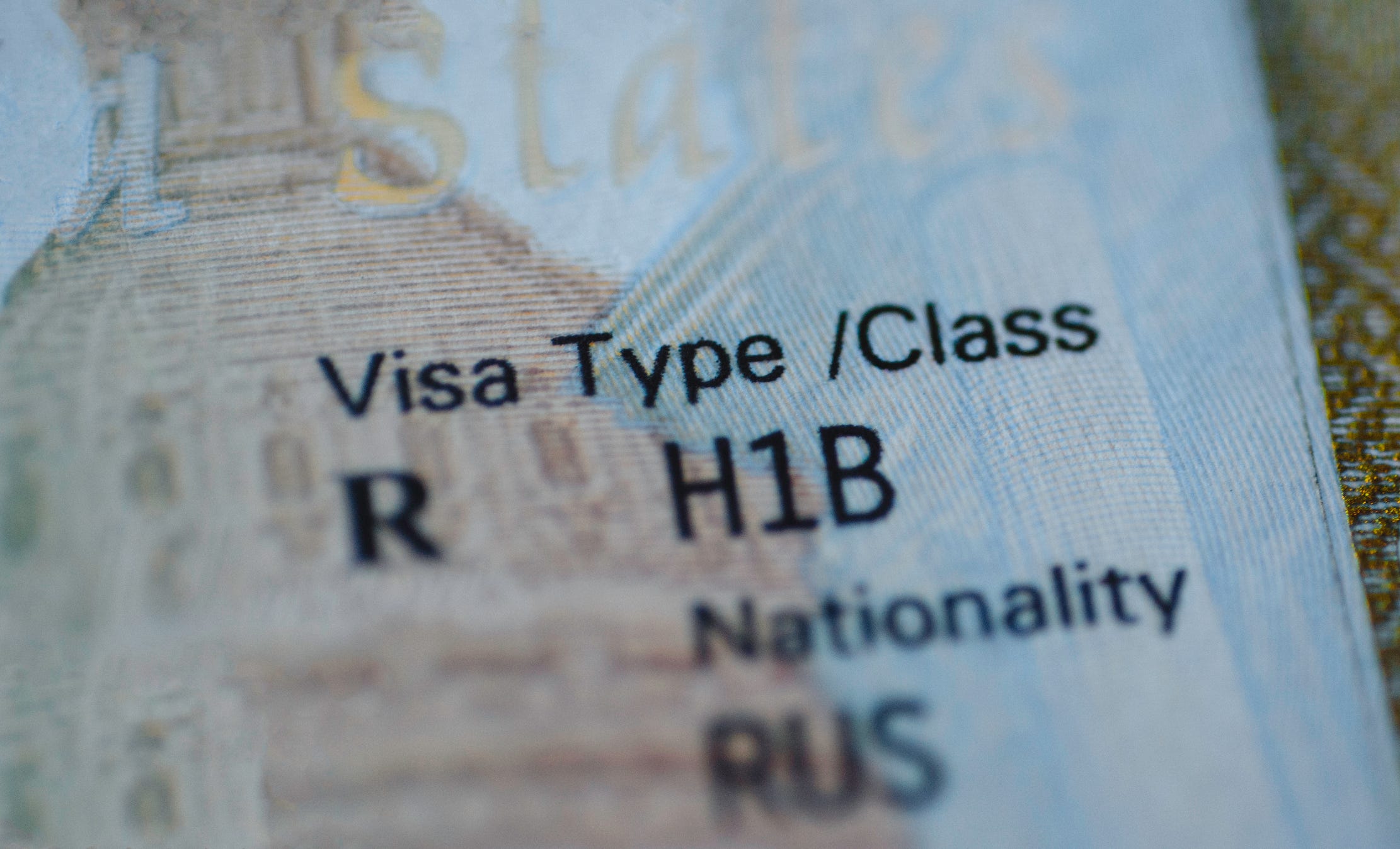
The H-1B immigration visa program has found itself near the center of the immigration debate, just behind deportations in its public salience. One of America’s few ways of prioritizing highly educated and high-earning immigrants, the program demands a job offer from a sponsor, and is limited to specialized roles requiring at least a bachelor’s degree.
Only 65,000 regular H-1Bs can be given out each year, plus 20,000 reserved to applicants with advanced degrees from U.S. colleges (as well as an unlimited number for employees of colleges and certain nonprofits). But instead of prioritizing the applicants with the best job offers for these limited slots, the system has long used a lottery. The world’s best and brightest have thus competed, on a literally randomized playing field, with unremarkable candidates funneled in by huge outsourcing firms.
For years, commentators pointed out how insane this was, yet Congress never fixed it. Then the Trump administration broke the logjam—naturally, using a series of executive actions that have proven controversial even among supporters of reform. These measures prioritize lottery entries for higher-wage applicants (albeit in a roundabout and flawed way) and impose a $100,000 fee on many H-1B applications (the fee is now held up in court).
The academic debate over H-1Bs has, therefore, never been more important. A while back, Manhattan Institute senior fellow George Borjas made waves with his finding that H-1B holders are underpaid relative to similar Americans, to the point that a revenue-maximizing fee for for-profit firms is likely in the range of $95,000 to $152,000.
A new working paper from Chad Sparber focuses on a different comparison: Instead of comparing natives with H-1Bs, he compares different types of H-1Bs with each other—with a special focus on those already in the country on F-1 student visas, as well as those applying from outside the country with no current immigration status, who together make up about 90 percent of the new visas issued under the caps.
Sparber’s conclusion is stark, if perhaps unsurprising. Those transitioning from F-1s make about 10 percent more than those newly arriving from other countries. The low wages of external applicants are specifically driven by those born in India—not because there’s anything wrong with Indians, but because several major outsourcing firms are based in that country and bring in applicants almost exclusively from there.
Using H-1B data from 2024, Sparber runs some straightforward models to measure differences across categories. Across the whole sample, H-1Bs from U.S. colleges out-earn those from outside the country by the aforementioned 10 percent. The gap is still 6 percent after controlling for a wide variety of factors like gender, education level, and whether the hiring firm is highly dependent on H-1Bs—but actually flips direction when applicants born in India are simply removed.
Sparber explains:
Amazon, Google, Microsoft, and Meta collectively hired thousands of cap-bound H-1B workers. They also hired many more workers already in the US and transitioning from F-1 status than new workers from abroad. Each of these firms paid their H-1B workers an average wage exceeding $140,000, and each hired a below-average proportion of Indian workers (though Amazon came close). … Contrast this behavior with Infosys and Wipro – India-based consultancies that employ India-born H-1Bs almost exclusively. They rarely hire workers directly from F-1 status in the US. When they do, those workers earn a premium, though overall average wages paid to H-1B workers by these firms are below $90,000.
In further analyses, Sparber shows that Indian-born applicants in computer-related fields applying from outside the country to jobs at highly H-1B-dependent firms are some of the lowest paid workers in the program—especially after controlling for their individual-level attributes. Some other combinations (such as non-Indians in computer fields applying to non-dependent firms) outearn them by more than half. Indians from F-1 status in computer-related jobs outearn them by a quarter at non-H-1B-dependent firms.
As Sparber puts it, “Firms that indiscriminately sponsor H-1B status from a pool of workers with fewer global opportunities can pay new US entrants low wages.”
Frankly, why are we doing this? Not only does the system fail to select the workers who’d benefit our economy the most, but it’s helped to stoke a bigoted backlash against Indian Americans, including specifically those at American colleges.
Indians didn’t decide to hand out extremely valuable visas in a random lottery and then fail to reform the system when the system was predictably swamped with mediocre applicants. Americans did.
The reforms the Trump administration is seeking have faced many legitimate criticisms, including here in City Journal. But there can be no doubt that the H-1B system is a mess, and we do need to fix it.
From Manhattan Institute
Charles Fain Lehman and Rafael A. Mangual defend the use of license-plate readers—and offer model legislation to safeguard against abuse.
Alex J. Adams and Adam N. Jones, both formerly of Idaho’s Division of Financial Management, explain how their state cut regulations.
Other Work of Note
With new DNA analysis, it appears overwhelmingly likely that Thomas Jefferson fathered children with Sally Hemings.
Another paper on AI and labor demand, and another. By the way, AI is getting cheaper extremely quickly, and Claude seems to have made a breakthrough in Anthropic’s new biology lab.
Delayed motherhood means delayed grandmotherhood, too.
Higher minimum wages lead to less community-college enrollment.
Colleges with high completion rates also have students with high test scores.
Universities are losing a ton of money on sports.
Breaking down the returns to education.
“These findings suggest that adolescents’ morning negative affect may shape how they engage with their mobile phones throughout the day,” rather than the other way around.
People facing economic uncertainty spend more time on housework.
Working from home reduces air pollution.
Connecting family structure to young-adult outcomes.
Do California’s workplace heat standards save lives?
The benefits of waiving fees for AP exams.
New issue of National Affairs, with pieces on reviving the inner city, protecting kids from online vice, and more.
Hospital desegregation in the 1960s had disappointing results.
“Sexual frustration was associated with cyber victimization and poor cyber hygiene.”
Interesting analysis of when long-term care is provided by spouses vs. Medicare.
The Fiscal Policy Institute claims that states with highly progressive taxes are also the most friendly to millionaires. Manhattan Institute’s Ken Girardin says not so fast.
Long-run effects of monetary policy.
How tariffs affect the manufacturing sector.
Why has wage inequality risen within occupations—and in some occupations more than others?
Steven J. Menashi and Elias Neibart revisit the birthright-citizenship debate.
Relaxing cosmetology licensing requirements makes life easier for those in school to enter the trade.
Thinking through the effects of a universal basic income, which can be implemented in numerous ways.
DAs throw more people in prison at election time.
Which types of weapon crime are more common in which types of neighborhoods?
How mental-health problems and substance-use issues relate to incarceration.
Did San Francisco’s civilian “guardians” reduce crime? Maybe, but note in the charts how much time passes between the program’s implementation and the alleged effect.
Stop making sensible claims.
Orange Man Bad!
Therefore anything at all he seeks to do must be wrong.
.
.
.
The actual problem is that the Dems in Congress refuse to reform the H1-B program on its own, insisting on tying it to “comprehensive immigration reform” which is code for allowing lots of illegal immigration plus a path to citizenship for those who came here illegally.