


Nikole Hannah-Jones’s regret at her decision to enroll her daughter in a low-performing public school, recently detailed in a long essay in the New York Times magazine, is probably a surprise to her. But among black New Yorkers, Hannah-Jones is the outlier. Over the past 20 years, as overall K-8 enrollment in New York City schools decreased by 15 percent, the black student population dropped by 54 percent—the largest decrease among all racial groups.
In the last decade, black enrollment in city charter schools increased from about 53,000 to over 65,000. Last year, a whopping 38 percent of black elementary students in New York City attended charter schools.
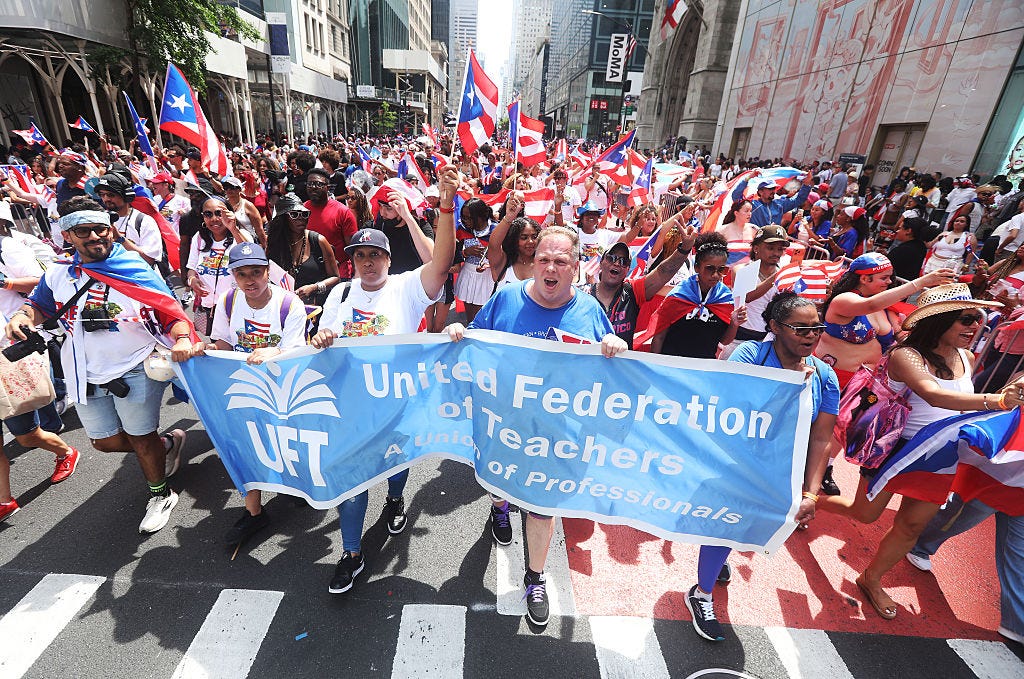
These black families are fleeing the public-school system to avoid exactly the challenges that Hannah-Jones found: lack of discipline, poor instruction, and the total absence of a system to measure students’ learning. Hannah-Jones blames this dysfunction on persistent inequality—wrongly. But she misses the true culprit driving the problems: the teachers’ union constraints on schools and the concurrent lack of accountability for low-performing schools.
The New York City teachers’ union contract prescribes most aspects of school operations, limiting principals’ ability to adapt to students’ needs. For example, the city school day is fixed at 6 hours and 20 minutes, regardless of circumstances. If a teacher offers extra tutoring before or after school, union representatives may ask them to stop so as “to not make other teachers look bad.” The contract results in New York City having the shortest school year among the five biggest districts in the state, with fewer instructional days than required by state law.
Teacher evaluations provide another example. In the 2022-23 school year, 94 percent of New York City public school teachers were rated very effective or effective, despite ongoing concerns about student achievement in basic skills. The union has spent decades fighting to keep these evaluations as opaque as possible, protecting teachers at the expense of families.
For example, in 2010, New York passed a law requiring the use of students’ test scores in teachers’ evaluation so they could receive federal funding. But the union has fought this linkage. In 2018, Jolene DiBrango, executive vice president of the New York State United Teachers, wrote an op-ed supporting a bill that would “decouple state standardized tests from teacher evaluations.” In 2024, the union celebrated another law, signed by Governor Hochul, that largely eliminated student performance as a component of teachers’ evaluation.
The union has even attempted to scuttle politicians who support better schools. They launched a campaign to unseat Eva Moskowtz from the city council because Moskowitz held hearings on their contract, highlighting restrictions like a prohibition on painting classrooms over 10 feet or the right of teachers from schools closed due to performance to get a job at another school.
Things haven’t always been this way. During the Bloomberg administration, the city implemented a school accountability system to identify struggling schools. But the DeBlasio administration, which was heavily influenced by the teachers’ union, eliminated the system. Now many families struggle to identify which schools the city deems low-performing.
It’s telling that Hannah-Jones offers no policy prescription for improving city public schools, just bemoans the entrenched nature of racial inequality. New York has dramatically increased public-school funding in the past 20 years, and now spends more than $40 billion per year with no improvement in students’ learning outcomes. Shouldn’t we look for the problem somewhere else?
Except , urban (and rural) schools with weak unions in the south and west are also terrible.
That’s why “it’s the unions!” has always been nonsense. Go look at Miami or Houston.
The Specialized High Schools also have union teachers and the students at those schools achieve terrific results.