


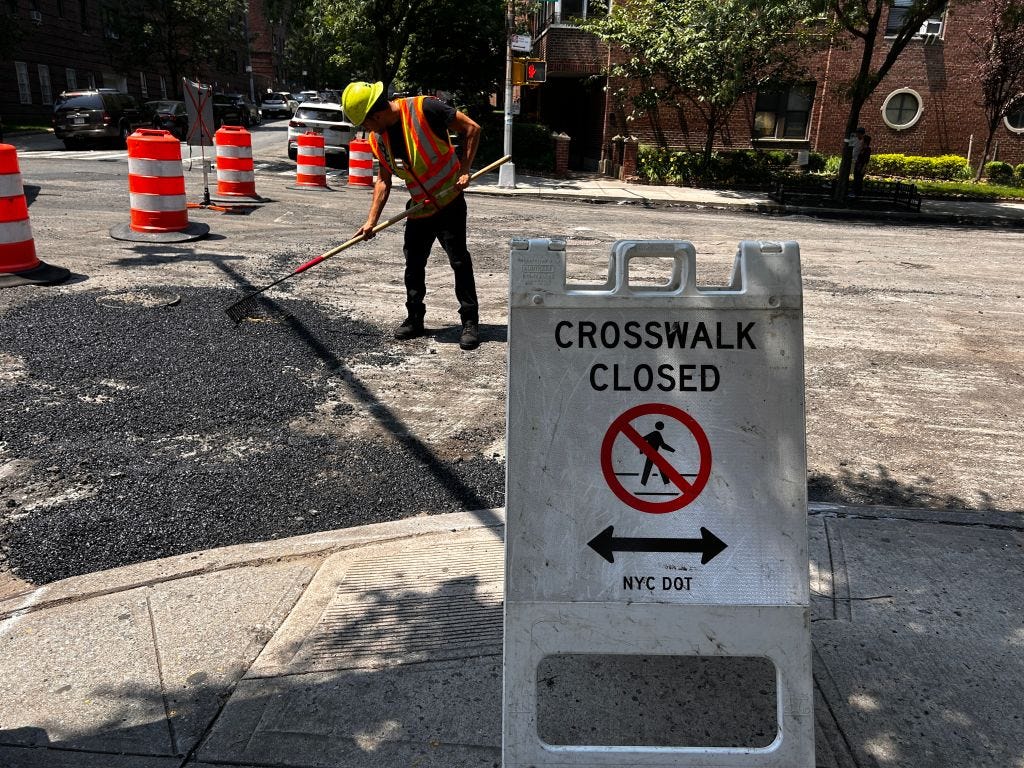
Zohran Mamdani understands the value of a good photo op. Days after taking office in January, he helped fill the notorious “bump” at the foot of the Williamsburg Bridge. Last week, he made another photo-worthy trip, this time to Troutman Street in Bushwick, to patch what the city says was its 200,000th pothole repair of 2026. “It’s the little things that say a lot about whether government is delivering for New Yorkers,” Mamdani said.
Mamdani is eager to prove that democratic socialism can make city government better at delivering the basics. Potholes are a fine place to start. But by the broader measures that shape daily life in New York, the city isn’t running nearly as smoothly as its streets.
Consider the evidence City Hall itself put forward. On the same day he filled the pothole, the administration released the first Mayor’s Management Report of Mamdani’s tenure and declared that it shows his “pothole politics” working across city government.
The report shows no such thing. For one, it covers fiscal year 2026, which ran from July 1, 2025, through June 30, 2026. Mamdani was mayor for only half of that period. Former mayor Eric Adams presided over the other half. The report’s annual totals do not separate Mamdani’s record from that of his predecessor.
The Citizens Budget Commission, the city’s nonpartisan fiscal watchdog, called it “hardly” a Mamdani report card for exactly that reason. The group also argues that the report tends to emphasize the quantity of work agencies perform more than the quality or impact of that work.
That said, some numbers are clearly moving in the right direction and deserve acknowledgement. As my colleague Rafael Mangual recently noted, the NYPD recorded the fewest shootings and murders through the first seven months of any year in the city’s history. The management report shows murders down about 20 percent and major felonies down more than 2 percent.
Other numbers look good too. Affordable housing completions rose 20 percent, to nearly 27,000 homes, the most in five years. The wait between sitting for a civil-service exam and getting results fell from 158 business days to 101. Mamdani cannot claim all the credit—the drop in violence, as Mangual notes, was years in the making and picked up speed after Jessica Tisch became police commissioner in 2024. Still, these trends are reason to celebrate.
Yet other core services are moving in the wrong direction. The combined response times for ambulances and fire companies responding to life-threatening medical emergencies increased 19 percent, to 9 minutes and 13 seconds, according to the report—well above the FDNY’s six-minute target. Street homelessness rose 11 percent, to nearly 5,000 people. Housing-maintenance complaints climbed 14 percent, to more than 950,000. The New York City Housing Authority’s rent-collection rate fell from 68.6 percent to 59.8 percent. A third of public-school students were chronically absent, and felony assaults in schools increased from 130 to 155.
To be fair, just as he cannot claim credit for every positive trend, Mamdani cannot be entirely blamed for every negative result. But these are not minor issues—they have direct effects on safety and wellbeing of city residents and reflect the basic functioning of city government. Mamdani says his administration came into office promising to “make government work for working people.” But the same report that shows smoother streets also shows the city’s performance deteriorating in other critical areas.
That may explain why Mamdani seems so fixated on filling potholes. Potholes are easy to count and photograph, so they make a convenient political symbol. But even those numbers should be put in proper context.
Fixing 200,000 potholes by mid-September—a rate of roughly 770 per day—is not historic by the city’s standards. Former mayor Bill de Blasio reached 1 million pothole repairs in March 2016, averaging about 1,250 per day from the time of his inauguration. Michael Bloomberg reported more than 400,000 in a single fiscal year, or more than 1,100 per day.
Meanwhile, the average time needed to resolve a pothole complaint made through 311 doubled from two days to four. That’s still within the Transportation Department’s five-day target, but it’s a trend in the wrong direction for an administration that insists on making pothole repair a symbol of competent government.
City governments earn trust by doing the basics well. Filling potholes is part of that job, but it says little about a city’s overall competence. Mamdani’s first management report offers encouraging signs in several areas, but it also shows serious shortcomings in “making government work” in other essential areas. Until those improve, Mamdani’s “pothole politics” is more symbolism than proof of effective governance.
