

When Clean-Air Rules Make Wildfire Smoke Worse
Federal regulations penalize the very tool that prevents extreme wildfires. It's time to fix that.

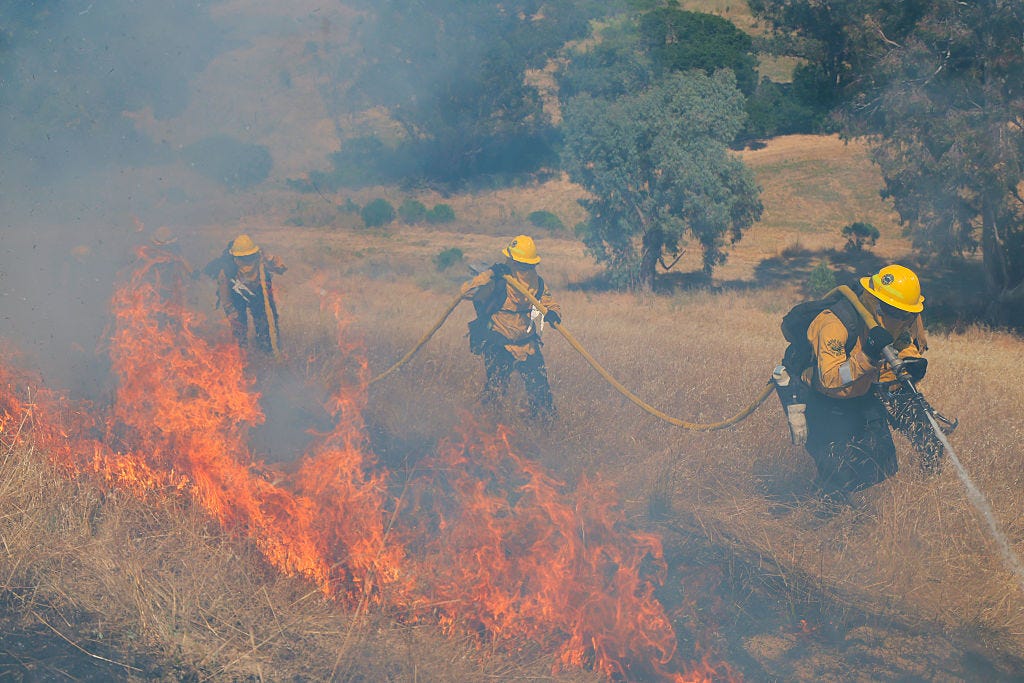
Wildfire smoke is once again spreading across the country—this time from fires raging in western states. Blazes in Oregon and Washington are sending plumes of smoke eastward, bringing hazy skies to parts of the Midwest and Northeast this week. Some of the smoke could even reach Florida and the Gulf Coast.
This has become an all-too-familiar summer ritual. In recent years, smoke from fires burning in the West—and in Canada—have darkened the skies and degraded air quality for hundreds of millions of Americans living thousands of miles from the flames. What few realize, however, is how federal air-quality regulations are making the problem worse.
For all the attention paid to tailpipes and smokestacks, wildfire smoke has become one of America’s largest and fastest-growing sources of air pollution. Yet the federal law designed to limit air pollution—the Clean Air Act—discourages one of the best tools we have for reducing that pollution: prescribed fire. A bipartisan bill introduced in the Senate last week would begin to correct that mistake. Lawmakers should waste no time acting on it.
The Clean Air Act was designed to regulate pollution from identifiable sources: power plants, factories, vehicles, and other facilities whose emissions can be permitted and controlled. Increasingly, however, its air-quality gains are being reversed by pollution from a more diffuse and unpredictable source: wildfires. In recent years, wildfire smoke has wiped out years of progress in reducing particulate matter and other emissions. A study published last month in Science, for example, found that wildfires had erased nearly four years of national progress in reducing ground-level ozone, a major component of smog that can damage lungs and aggravate respiratory illness.
Yet the Clean Air Act discourages one of the most effective ways to reduce catastrophic fire and smoke. Under current law, the Environmental Protect Agency generally allows states to exclude wildfire smoke from federal air-quality calculations, but not smoke from prescribed fires—the smaller, carefully planned burns that help prevent more destructive wildfires. The result is a perverse incentive: uncontrolled wildfire smoke gets a free pass, while the controlled fires that could reduce it are regulated and discouraged.
The problem lies in how the Clean Air Act treats what it calls “exceptional events.” When determining whether a region complies with federal air-quality standards, the EPA allow states to exclude pollution that is beyond their reasonable control. To qualify, the pollution must be from an event that “affects air quality,” is “not reasonably controllable or preventable,” and results from natural causes or from “human activity that is unlikely to recur at a particular location.”
Wildfires typically fit within that framework. Federal rules generally presume wildfires are natural events beyond a state’s reasonable control and therefore satisfy the exceptional-events standard. States must still meet basic procedural and reporting requirements, but excluding wildfire smoke from their compliance calculations is common and typically relatively straightforward.
Prescribed fires are another matter. Because these fires are deliberately set, they are by definition preventable. And because most landscapes require periodic burning, they are likely to recur. That makes them a poor fit for the EPA’s exceptional-events rule.
States can still ask the EPA to exclude prescribed-fire smoke, but they must demonstrate case by case that a burn satisfies the law’s ill-fitting criteria. Fire experts and practitioners have described the process as “exceptionally onerous” and the exceptional-events rule as “an ineffective tool to discount emissions from prescribed fire.” Only one prescribed burn has reportedly received such an exemption since the rules were revised in 2016. A Georgia forestry official told a Senate committee last year that the state had submitted 89 exceptional-events demonstrations in recent years. The EPA had not approved or denied a single one.
This arrangement gets the incentives backwards. The extreme wildfires that produce dangerous smoke receive a regulatory exemption, while the smaller fires that reduce that danger count against a state’s compliance with federal pollution limits. The EPA has recognized the problem and tried to make its procedures more workable. But administrative guidance can go only so far. It cannot eliminate the underlying mismatch in the statute.
The costs of falling into “nonattainment” under the Clean Air Act can be substantial. States that fail to meet federal standards may face tighter permitting rules, additional planning requirements, restrictions on economic development, and the possible loss of federal highway funds. Wildfire smoke is increasingly what pushes areas over the line. Researchers at Stanford and the University of Washington estimate that, among monitoring stations that exceeded the daily standard at least once during the past five years, 91 percent would have remained below it absent wildfire smoke.
With so much at stake, regulators often restrict prescribed burns, reduce their size, or decline to approve them to avoid adding more smoke to the record. Burn managers, knowing that approval may be difficult, may scale back their plans. The result is less beneficial fire and more fuel to feed larger, more destructive wildfires.
Fortunately, Congress is starting to take notice. Last week, Utah senator John Curtis introduced the Wildfire Emissions Prevention Act. Backed by a bipartisan group of cosponsors, the bill would explicitly add prescribed fire to the Clean Air Act’s definition of an exceptional event, giving states greater assurance that beneficial burning will not trigger federal air-quality penalties. Rather than forcing regulators to squeeze prescribed fire into the existing framework, the bill would recognize it as a valid intervention to prevent a larger and less controllable source of pollution.
The legislation would also impose a deadline on EPA reviews of such exemptions. The agency would have one year to approve or reject a state’s application. If it failed to act, the application would be approved automatically. That provision would prevent demonstrations from languishing for years, as Georgia’s and other states’ have.
A similar proposal, the FIRE Act, passed the House in April. Neither bill would give land managers carte blanche to burn. States would still regulate prescribed fire, burns would remain subject to smoke-management rules, and practitioners would still have to take reasonable precautions to protect nearby communities. The legislation would simply stop the Clean Air Act from penalizing states for using one of the most effective tools available to reduce extreme fire and smoke.
The benefits of more prescribed burning can be substantial, and long lasting. A new Stanford-led study examined two decades of California data and found that low-severity fire from prescribed burns immediately reduced the risk of a subsequent very severe fire in the same location by 92 percent. The benefit lasted for as long as a decade and extended roughly three miles beyond the burned area. A little controlled smoke now, in other words, can prevent much more smoke and devastation later.
Western states increasingly recognize this tradeoff and have begun removing state-level barriers to prescribed fire. California recently established a $20 million claims fund to cover damages from eligible prescribed burns. Oregon paired a certified burn-manager program with a fund covering up to $1 million in damages. Last year, Washington authorized a similar pilot program that can reimburse up to $2 million per claim. But these state efforts will accomplish little if beneficial burns still push a region out of compliance with federal air-quality standards—or if seeking an exemption is so burdensome that it is not worth attempting.
We know that prescribed fire can reduce hazardous fuels, restore fire-adapted forests, and limit the severity of future wildfires. States are beginning to clear away the barriers that stand in its way. Congress should do the same. Clean-air regulations should help states produce cleaner air—not penalize them for preventing the fires that make it dirty.