

Whose Streets?
Half of Los Angeles's street homeless are from somewhere else. Here's why that matters.

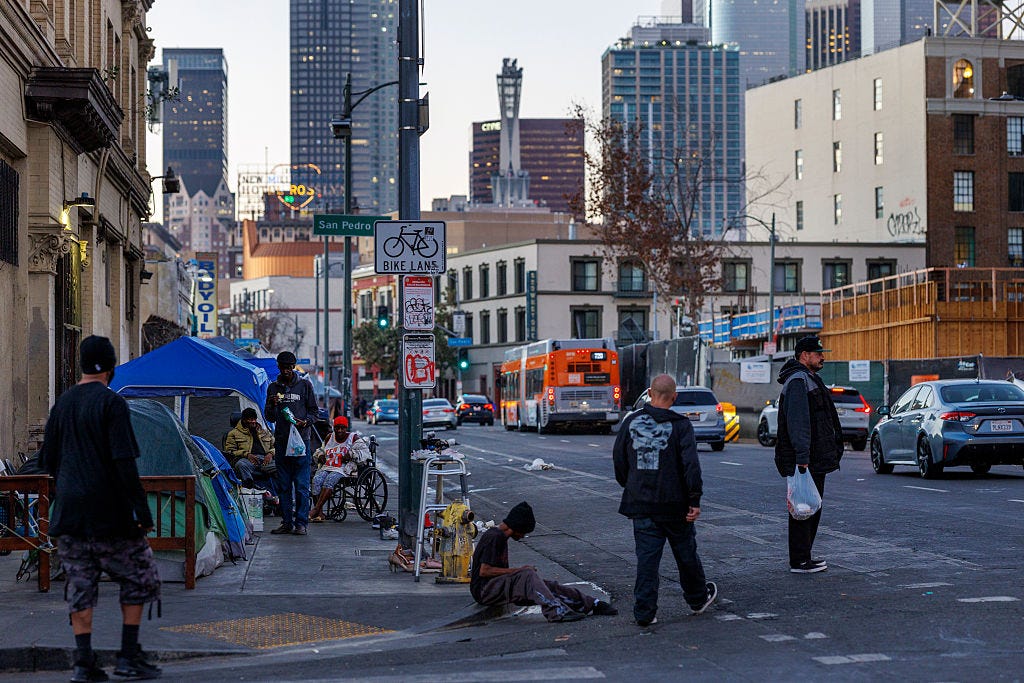
Los Angeles has a homelessness problem. The city holds 3 percent of the American population, but 10 percent of the nation’s homeless people. According to federal data, it has the second-largest homeless population, after New York City. But New York City’s population is more than twice that of Los Angeles, and Los Angeles’s unsheltered homeless population is more than 10 times larger than that of New York.
Many of those people, it turns out, aren’t even from Los Angeles. City Journal’s Christopher F. Rufo and Kenneth Schrupp surveyed the homeless in three of the city’s neighborhoods about where they were from originally. More than half (53 percent) reported being from outside Los Angeles County. That’s higher than, but consistent with, rates previously reported by the Los Angeles Homeless Services Authority (31 percent) and the RAND Corporation (41 percent).
As Rufo and Schrupp observe, there’s something like a magnet effect going on here: policies meant to help a homeless population inadvertently makes the experience of homelessness in the city more attractive, drawing in people from less generous jurisdictions. That’s a problem not just for the city coffers, but for urban life in general—and the rest of the public has every reason to push back.
Of course, uncontrolled homelessness is nothing new to the City of Angels. But it’s become a flashpoint in the upcoming mayoral election. Incumbent Karen Bass has sought to defend her record. Nithya Raman, the DSA member and city councillor challenging Bass from the left, has promised to cut encampments in half by expanding the supply of shelter and permanent housing. Reality star Spencer Pratt, running against Bass from the right, thinks Los Angeles “does not have a homelessness crisis because taxpayers spent too little,” but because billions have flowed to an unaccountable homelessness NGO complex that he would dismantle.
Whatever the merit of these three approaches, they mostly don’t touch the idea implied by Rufo and Schrupp’s street survey, that many homeless people live in L.A. because the services it provides are generous. And generous they are—the city has budgeted nearly $1 billion for homelessness. California as a whole spent over $20 billion between 2019 and 2024, even as homelessness rose statewide.
In addition to all those dollars, there’s another obvious reason for that recent increase: the Ninth Circuit’s declaration, in Martin v. Boise, that enforcing camping bans without adequate shelter amounted to cruel and unusual punishment. As my colleague Judge Glock noted, homelessness rose 25 percent in the Ninth Circuit in the year after Martin was handed down, even as it declined in the rest of the country. (In 2024, the Supreme Court finally struck down Martin in Grants Pass v. Johnson with the support of numerous California cities, including Los Angeles.)
The interesting question is not so much whether these policies tend to attract people—they plainly do—as why, given their magnetic effect, cities like Los Angeles and states like California continue to insist on using them. Why is it that progressive jurisdictions seem to want to create conditions conducive to homelessness?
Homelessness activists in Los Angeles, to be fair, rarely say that they’re trying to attract a large homeless population. They instead claim it’s a “myth” that many homeless are from outside the city. At the same time, activists generally oppose bussing homeless people out of town. And they also don’t want to respond to bussing in with bussing out, instead endorsing an expansion of services. All three positions imply a view that non-resident homelessness is not a problem per se but, at worst, a problem of too few resources.
In a sense, that’s true. A great deal of homelessness is a “housing problem,” and the aggressive regulatory burdens Los Angeles and California impose on homebuilding are a big reason why the state has so many residents who can’t afford a home. And it is certainly the case that homeless people deserve care and compassion—access to food, shelter, and treatment for addiction or serious mental illness where appropriate.
At the same time, homelessness—especially chronic, unsheltered homelessness—measurably generates social problems. Research shows, for example, that moving homeless people into shelter reduces crime. So does clearing homeless encampments. That’s consistent with a view in which homeless-at-scale—not merely a few homeless people, but communities of homelessness such as one sees in Los Angeles and other West Coast cities—are public nuisances the abatement of which serves the public interest.
The progressive view tends to downplay or altogether ignore these negative externalities, or, when forced to confront them, insists that the problem is yet again a lack of access to resources. But if there is a magnet effect—and, more generally, if progressive policy has the inadvertent effect of making homelessness more sustainable—then more resources can in fact make the social problems associated with homelessness worse. Indeed, communities of homeless people like those in Los Angeles or San Francisco can and do generate problems that simply would not exist if there was not the same infrastructure for homelessness in the city.
There is, in short, an intrinsic tension between the interests of the unsheltered homeless and the interests of the non-homeless in a city. That interest is not merely the result of insufficient resources. It’s intrinsic to what public camping and other disorderly behaviors are—domination of public space for private purposes. The person who sleeps on the sidewalk or shoots up on the street corner is excluding other people from the enjoyment of that nominally public space. Subsidizing the former person’s lifestyle necessarily does some harm to the people sharing a community with him.
The fact that such a trade-off exists doesn’t mean we need always and everywhere to select against subsidizing homelessness. It’s right and good for cities to provide some measure of charity to people in need. Rather, the reality of the trade-off constrains how generous we can be. As cities like Los Angeles demonstrate, sufficient generosity becomes cruel to everyone else subsidizing that generosity.
It’s reasonable, therefore, to ask whether the people living on the streets of a city are actually from that place—whether they actually have claim to the limited set of public resources (always provided less efficiently than market products) the city makes available to those in need. If they don’t, then a bus ticket may be the best solution.
Such “gatekeeping” of public resources isn’t cruel. It’s a way to ensure that everyone’s interests are served—both the homeless and those who live around them.
You have to do more work to explain why being from a certain county makes a person deserve the public resources from only that county. You assume the connection here with no explanation-
“It’s reasonable, therefore, to ask whether the people living on the streets of a city are actually from that place—whether they actually have claim to the limited set of public resources (always provided less efficiently than market products) the city makes available to those in need.”
Cities and counties get a lot of money from the federal government, and counties get money by taxing businesses who have customers all over the country. This is particularly true in places like New York, LA, San Francisco. Maybe a person grew up in some suburb in the Midwest. The community they grew up in pays money to the federal government, and the people who live there buy products and services from companies headquartered in major cities. So why shouldn’t social insurance paid for by federal taxes and local taxes on national revenues go to that person wherever they pick up the service in the US?
The US isn’t Europe, or Ancient Greece. This is one country, every citizen is “from” every part of the country.
How much of LA’s housed population is from somewhere else?