

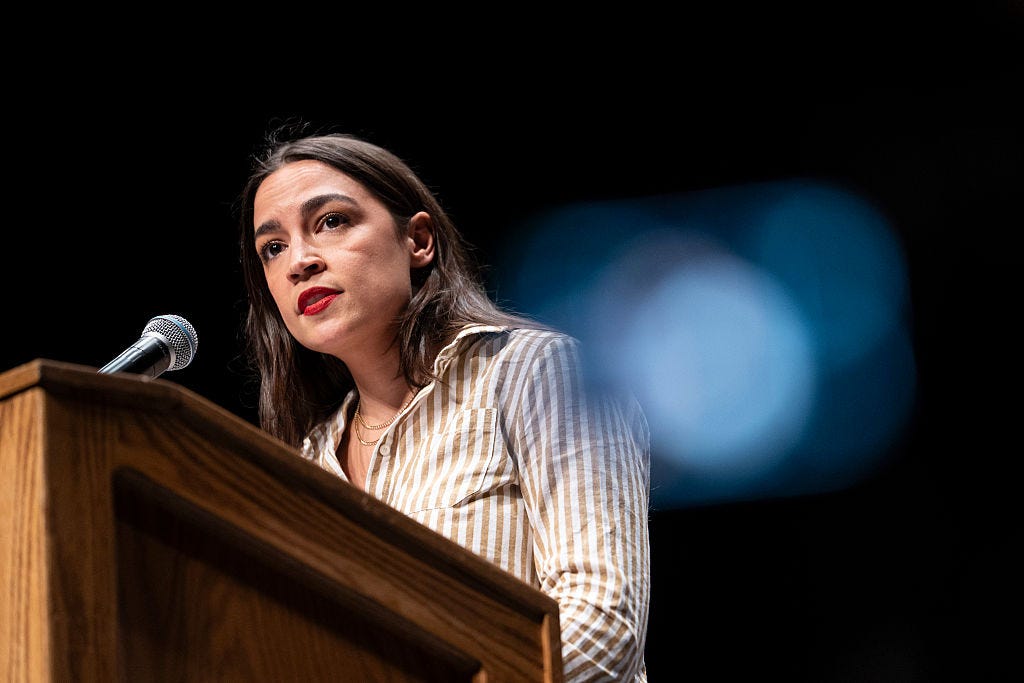
By Rohit Goyal
Recently, Rep. Alexandria Ocasio-Cortez caused a stir with her admission that “Woke 1 was crazy.” Ocasio-Cortez acknowledged the excesses of her past rhetoric but chalked them up to pandemic-era disorientation. Some commentators took issue with the flippancy of her mea culpa. Others focused on the implication that if what occurred was just “Woke 1,” a sequel must be in the works.
I share these criticisms. But critics of Ocasio-Cortez’s comments err in accepting the premise that Woke 1 is a thing of the past. While Democrats have retreated from the policy, rhetorical, and tactical excesses associated with “peak woke,” they still cling to the worldview that produced them.
The misunderstanding begins with disagreement over what wokeness is. With no settled definition, the term has become a catchall for several overlapping phenomena. According to one view, wokeness is a general fixation on injustice against racial minorities, sexual minorities, and women. According to another view, it is “a system of enforced ideological conformity, policed by social bullying and institutional coercion.” Sometimes, wokeness denotes a preoccupation with esoteric, politically correct language: “Latinx,” pronouns, and so on. At other times, it refers to a set of radical policy demands, including, most famously, defunding the police.
Each account captures an important facet of wokeness, but none gets at its most politically consequential feature. None quite identifies what it was about wokeness that alienated voters from the Democratic Party.
Consider “defund the police.” Following the 2020 elections, many Democrats blamed the slogan for their underperformance. Data maven David Shor quantified its unpopularity, and Barack Obama urged Democrats to reject it.
They did. In his 2022 State of the Union, President Biden won bipartisan applause when he declared, “We should all agree: The answer is not to defund the police. It’s to fund the police.” Yet Democrats continued to struggle in 2024, and research since then has found that they remained dogged by widespread perceptions that they are woke. If these perceptions outlasted the rise and fall of the “defund” movement, then evidently something larger was at work.
What alienated voters about wokeness was not simply that it prescribed radical policies that would have harmful consequences if enacted. What alienated voters was the broader worldview animating those policies and the redistribution of moral status it entailed.
Survey data reveal that, over the past decade, Democrats have moved sharply left on race. They have become more likely to attribute racial inequality to slavery and discrimination and to support race-conscious policies to address it. Underlying these attitudes is a worldview in which disparities in everything from academic achievement to economic outcomes to crime rates are understood primarily as products of past and present injustice: groups that fare poorly do so because they suffer oppression, while groups that fare well do so because they enjoy privilege. Democrats have increasingly extended this framework beyond race to gender and sexual orientation.
In this account, widely prized values such as hard work, personal responsibility, and self-discipline are of only secondary importance in explaining outcomes. When Democrats traffic in particularist rhetoric by foregrounding specific groups and advocating preferential treatment for them, they convey that certain people face uniquely grave challenges because of their identity and, in turn, minimize the hardships and sacrifices of others. The result is an inversion of the moral hierarchy, as virtue is discounted, transgressions are excused, and group identity takes precedence over individual adversity.
Democrats held this worldview before the convulsions of 2020. They maintained it after disavowing “defund the police.” And they remain committed to it even as they claim to have moved on from “Woke 1.”
Recently, for example, Pete Buttigieg defended the “fairness” of race-conscious policies by invoking narratives about the intergenerational persistence of racial inequality that are inconsistent with research by Raj Chetty. Andy Beshear advocated restoring race-conscious policies on similar grounds. Wes Moore asserted that “bigotry … is costing this country” and that “it is costing this country when you do not have an inclusive economy.” And Ro Khanna said, “The Black community was excluded from the agricultural revolution, excluded from the industrial revolution in many ways. Shame on us if the Black community will be excluded from the AI and digital revolution”—as if the barriers to economic opportunity in the past are comparable to conditions in the present.
To see how far contemporary Democrats remain from their predecessors, consider Barack Obama’s remarks at Morehouse College’s commencement ceremony in 2013: “Nobody cares if you suffered some discrimination … whatever you’ve gone through, it pales in comparison to the hardships previous generations endured—and they overcame them. And if they overcame them, you can overcome them, too.”
Democrats may be past peak woke, but they are still plenty woke.
Rohit Goyal is a Law School Associate at the Manhattan Institute and a student at Yale Law School.
Obama's excellent quote sounds right wing by today's standards.
Exactly correct.
I’ve been saying the same thing for a couple weeks now.
And even prior to “Woke 1 is crazy”, even if we all agree that we’d hit Peak Woke, it doesn’t mean that the downslope is steep. In fact, the downslope has been fairly mild and may just turn into a plateau.